Charlie Kirk Death: Who Is the Shooter and What He Said About Gun Deaths
When I first heard Charlie Kirk’s remark that “some gun deaths are worth it” to preserve the Second Amendment, my first reaction was confusion. How could someone so casually place a price tag on human life? Yet, this wasn’t a throwaway line. Charlie actually said this at a public Turning Point USA event in Salt Lake City in 2023, in front of young people asking about gun violence. His words have resurfaced now, following his death, and they force us to confront an uncomfortable question: is this really where America’s gun debate has ended up?
Charlie Kirk’s Controversial Statement
Kirk told the audience:
“I think it’s worth to have a cost of, unfortunately, some gun deaths every single year so that we can have the Second Amendment to protect our other God-given rights.”
That framing stunned many. He wasn’t the first to argue that rights come with risks, but he made it sound almost transactional – as if the lives lost to shootings are collateral damage in defense of liberty. For grieving families who have buried children after school shootings or lost loved ones to random violence, the remark cut deep.
America’s Gun Problem
The United States isn’t like most countries when it comes to firearms. According to the Small Arms Survey, America has more civilian-owned guns than people. There is an estimated 393 million guns for 331 million people in America. Compare that to Singapore, where strict laws make civilian gun ownership practically non-existent, or Ghana, where gun access is limited and controlled.
With this reality comes a staggering toll:
- Over 40,000 gun-related deaths each year, including homicides, suicides, and accidents (CDC data).
- Mass shootings that dominate global headlines (from schools to shopping malls, churches, and concerts).
- A generation of students who practice active shooter drills the way previous generations practiced fire drills.
For many Americans, the constant possibility that daily life could be disrupted by gunfire is normal.
Why Some See It as “Worth It”
To be fair, supporters of Kirk’s view don’t celebrate gun deaths. Instead, they argue that freedom comes with risk. The Second Amendment, in their eyes, is a safeguard against tyranny, ensuring that no government can disarm the people. For them, restricting gun rights is a slippery slope. They believe that once freedom is given up, it is rarely returned.
It’s a philosophical stance when you think about it critically. Liberty even at the cost of safety. It’s similar to how some people accept traffic deaths as the “cost” of having cars and highways. But then again the comparison is imperfect. Cars are built for transport. Guns are built to kill.
Why Other Americans See It as Unacceptable
For critics, Kirk’s remark summed up the problem with America’s gun culture. Treating preventable deaths as a price worth paying shows how normalized gun violence has become. Imagine telling parents in Uvalde or Parkland that their children were part of the “cost”.
In most parts of the world, this idea is unthinkable. In Singapore, Dubai, or even Poland, political debates are fierce, but mass shootings are virtually unheard of. Citizens don’t frame freedom as a trade-off for random violence. Instead, laws balance rights with public safety in a way that Americans often resist.
Charlie Kirk’s Death: Dying for What He Believed In?
Kirk’s remark about gun deaths being “worth it” has taken on an eerie weight since his own tragic end. On September 10, 2025, he was shot and killed during a Turning Point USA event at Utah Valley University. Just moments before, he was doing what he always did, which involved him engaging with young people, defending the ideas he believed in most fiercely.
In a way, his death has been described as ironic, even haunting. He spent years arguing that the right to bear arms was so fundamental that even lives lost to shootings were an acceptable price. And then, his own life was cut short by gunfire in a public setting.
Kirk lived by the sword of rhetoric, and some might say he died by the same. He pushed a message that guns and freedom were inseparable. And in the end, he became a victim of the very violence he insisted society must accept.
Timeline of the Shooting of Charlie Kirk

The scene outside Utah Valley University after the Charlie Kirk shooting, where his Turning Point USA event came to a tragic end.
The Event Begins
On the afternoon of September 10, 2025, Utah Valley University in Orem, Utah, became the stage for Charlie Kirk’s American Comeback Tour. A crowd of thousands packed into the venue, eager to witness the Turning Point USA founder speak. Kirk, known for his confrontational style, was taking questions and pushing his familiar themes of free speech, conservative values, and cultural battles.
The Moment of Violence
Roughly twenty minutes into the program, just as Kirk was addressing a student’s question about mass shootings, a gunshot shattered the atmosphere. The bullet struck him in the neck, and the packed auditorium erupted into chaos. Eyewitnesses describe people diving for cover, some rushing to the exits while others froze in shock. Security raced to Kirk’s side, pulling him off stage as the crowd scrambled to safety.
Panic on Campus
Within minutes, Utah Valley University officials canceled classes for the rest of the day and shut down the campus. Students were urged to shelter in place while police secured the area. Social media lit up with conflicting reports: some insisted a suspect had been taken into custody, while others said investigators were still searching. The uncertainty only added to the fear spreading through the community.
A Race to Save Him
Paramedics rushed Kirk to the hospital, where he was reported to be in critical condition. Emergency surgery was attempted, but the wound was too severe. News outlets across the country began breaking into regular programming to report on the shooting, with updates trickling out by the minute.
The Announcement of His Death
At approximately 2:40 p.m. local time, the confirmation came. Former President Donald Trump posted on social media that Charlie Kirk had died from his injuries. The statement stunned supporters and critics alike, turning what had begun as a day of political theater into a national tragedy.
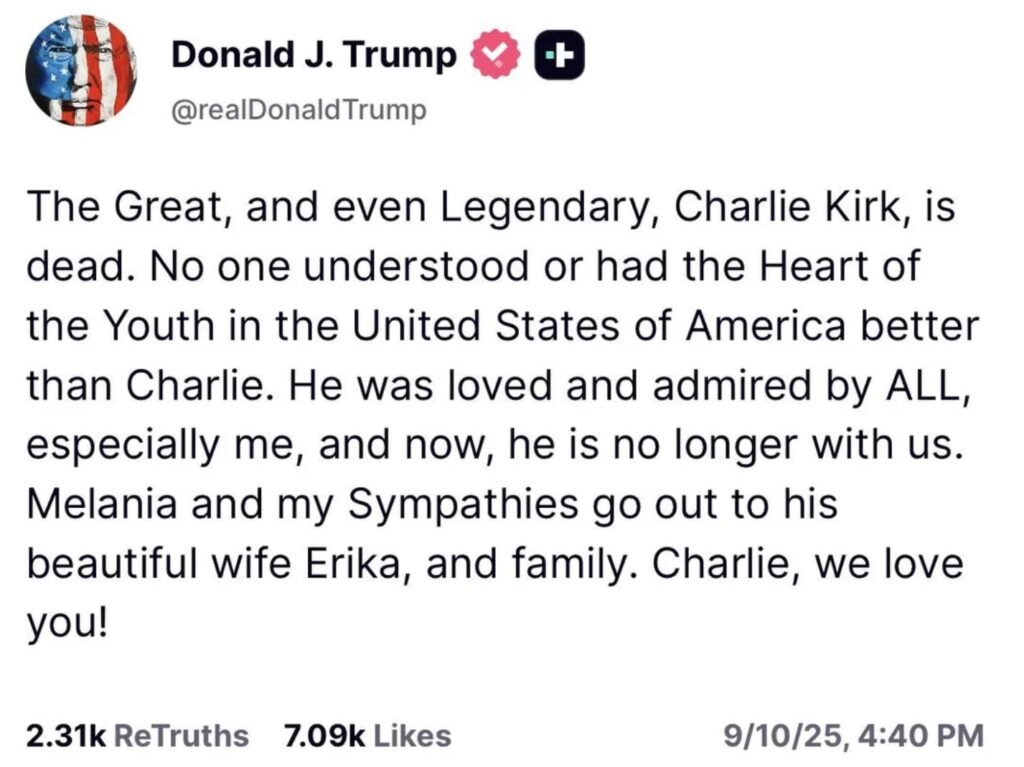
Donald Trump took to Truth Social on September 10, 2025, to confirm Charlie Kirk’s death and send condolences to his wife and family.
The Aftermath
As night fell, federal agencies including the FBI and ATF joined local authorities in investigating the shooting. The gunman was reported to have fired from a distance, raising questions about security failures and the motive behind the attack. The Utah Valley campus remained closed, and students who had come for a spirited debate instead left with memories of panic, fear, and violence.
Who Was the Charlie Kirk Shooter?
Since the moment Kirk was shot, one question has dominated the conversation: who pulled the trigger? Everyone wants to know the identity of the shooter, but the truth is that as of the time of writing this post, these details remain limited and rumors are spreading faster than facts.
Here’s what we know so far. The gunman fired from a distance. According to reports, the shooter fired say from a rooftop about 200 yards away from where Kirk was speaking. Witnesses described a figure dressed in all-black tactical gear, complete with helmet, mask, long pants, and even aviator-style glasses. It looked like someone who had prepared carefully for the attack.
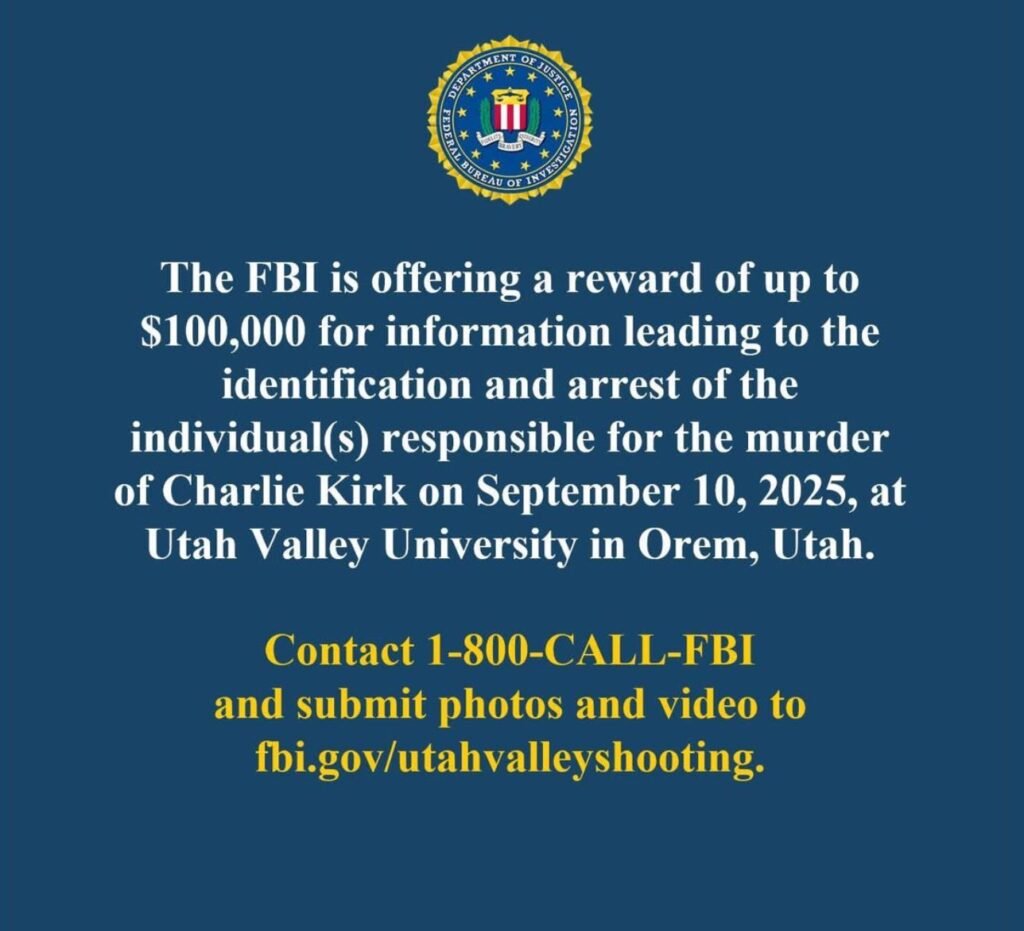
Early on, police detained a person of interest, but that individual was later released. Investigators have made it clear that this was not the shooter. The FBI and ATF are now assisting local authorities, and the manhunt continues. The FBI even offered $100,000 reward for any information that would lead to the arrest of the shooter.
The suspect, 22-year-old Tyler Robinson, was eventually captured after a 3-day man hunt. This was officially revealed by President Trump. According to reports, it was Tyler’s own family member that turned him into authorities after he confessed to his father.
What Charlie Kirk’s Death Reveals About America
If anything, Kirk’s tragic demise casts light on the deep paradox of the American gun debate:
- The culture of risk: The U.S. has chosen a path where nearly anyone can access a firearm, even in a crowded campus hall.
- The symbolism of martyrdom: To his supporters, Kirk will be remembered as a man who stood firm, even in the face of hostility. His death only amplifies his message in their eyes.
- The tragic cost: To critics, his death is proof of how broken America’s relationship with guns really is. It shows that no one (not even a loud defender of gun rights) is safe in a country where shootings have become routine.
As I reflect on this from a global lens, I can’t help but think about how impossible in a place like Singapore it would be for a political figure to be shot dead in a university auditorium. Yet in America, this has become a story that feels both shocking and strangely predictable.
That being said, Charlie Kirk’s legacy will always be polarizing. To some, he was a fearless warrior for freedom whereas to others, he was a voice that pushed division. But his death seals one undeniable truth. And that is he lived and died wrapped up in the very issues he spent his life fighting about.
What America Can Learn from the World
Travel has taught me that every country defines freedom differently. In Singapore, people trade some freedoms for safety. In the end, strict laws keep streets of Singapore clean and crime low. In Dubai, heavy regulations create a sense of order, where violent crime is rare. In Ghana, communities depend more on each other, and while challenges exist, random mass shootings are not part of daily fear.
America is unique in its obsession with guns. The Second Amendment is woven into its DNA, but the question remains: at what cost? Charlie Kirk believed that even thousands of lives lost each year were “worth it” to keep gun rights untouched. His own death by gunfire forces us to confront whether that trade-off still makes sense in 2025.
When I look at this as a traveler, the contrast is clear. In much of the world, freedom is measured by how safe you feel walking home, taking public transport, or attending a community event. In America, freedom too often comes with the shadow of gunfire.