African Black Soap: Types, Benefits, and How to Use It (With Photos)
Long before imported bath products arrived, West Africans used a locally made cleanser for bathing and household cleaning. Today it is widely known as African Black Soap. It is believed to have originated in Nigeria and was first documented among the Yoruba people. Through trade, the soap made its way into Ghana and became part of everyday life.
Across Ghana it goes by many names. In the Southern part of the country you will hear Alata Samina. In Northern Ghana, Dagombas may call it Awablah or Kulkul chibo, and Mamprusi often say Zangua. The recipes vary by region and even by household, but the idea is the same – a natural soap made from plant oils and alkali derived from burnt botanical matter.
Types of African Black Soap
The following are the kinds of African Black Soaps you’ll see in most Ghanaian and African markets:
1) Crumbled / “Powdered” Black Soap

What it is: After heating and separating the soap, makers let it cool and crumble it into coarse pieces. Locals simply call this the “powdered” version.
Look: Light to semi-dark brown, pebble-like chunks (often sold loose in cups or sealed bags).
Packaging: Bagged, or scooped into a container at purchase.
Why people choose it:
- Easy to portion, melt, or dissolve into liquid soap
- Great for DIY mixes (adding extra shea butter, coconut oil, honey, etc.)
- Mild, gently exfoliating texture
2) Dark Molded Black Soap

What it is: The same base soap usually wrapped in cement-bag paper to set into a firm cylinder or puck.
Look: Dark brown to almost black, dense, with natural cracks on the surface.
Packaging: Commonly wrapped in repurposed cement-bag paper (a classic, durable local wrap), or sold as small wrapped bars.
Why people choose it:
- Compact and long-lasting
- Travel-friendly and tidy. You just slice off what you need
- Feels slightly more concentrated; produces a creamy, rich lather
3) “White” Village Soap (aka Tolon Banku)
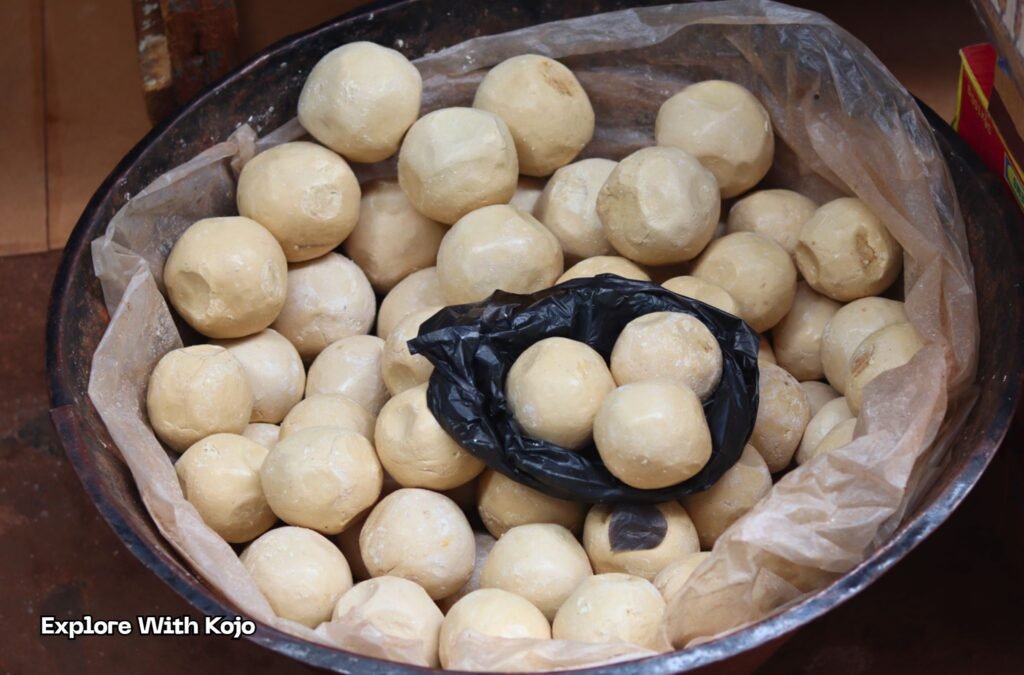
What it is: A local Northern-Ghana variant made with shea butter and ash leaves. It’s distinct from the dark black-soap family but often sold beside it.
Look: Off-white balls or pucks, usually wrapped in plastic.
Traits: Very hard and water-resistant
Why people choose it:
- Extremely durable (great in humid places and for frequent washing)
- Simple, shea-forward formula that some users find gentle on skin
What goes into African Black Soap

At its core, black soap is made with palm kernel oil, shea butter, and a plant-based ash (often from cocoa pod husks) that provides the alkali needed for saponification. Neem oil, coconut oil, moringa powder, and plantain leaves are sometimes added for purpose or customer preference.
To understand the texture differences and the exact process, we spoke with Lawrence Owusu, production manager for the black soap line at Sooglu Enterprise in Tamale, Ghana. In his words:
On ingredients, he explains: “The ingredients include pumpkin – different types of pumpkin. We usually buy the kind that’s extracted from the nut, the raw one, which is palm kernel. Then there’s shea butter and neem oil. Sometimes we also add moringa powder. And for the potash, we burn the cocoa pod into ash, then mix it with water and sieve it.”
How it is made
Every maker has their own ratios, but Lawrence shared the exact measurements they use at Sooglu.
“So what we do is measure the palm kernel first. For shea butter, we use six kilos; for palm kernel, five kilos. Then we add the other ingredients – coconut oil and neem oil – which all come together.
We normally use a small measuring cup that holds about 890 grams. At the start, you pour three cups of 890 grams each into the oil and let it boil for a while.”
The potash is added gradually while the mixture continues to boil.
“You’ll reach a stage where you can see from the texture of the soap itself that it’s time to add another three cups of 890 grams. The final stage also takes another three cups. During this process, you need to keep stirring continuously as it boils.”
Once the mixture thickens, they take it off the fire, allow it to cool, and then re-melt it to perfect the texture.
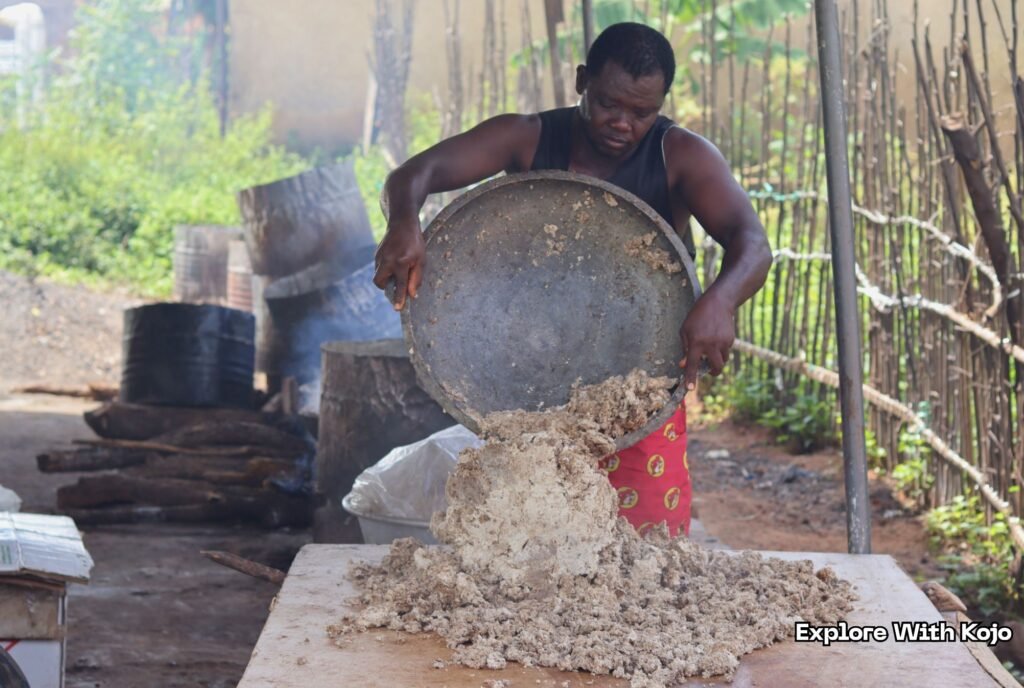
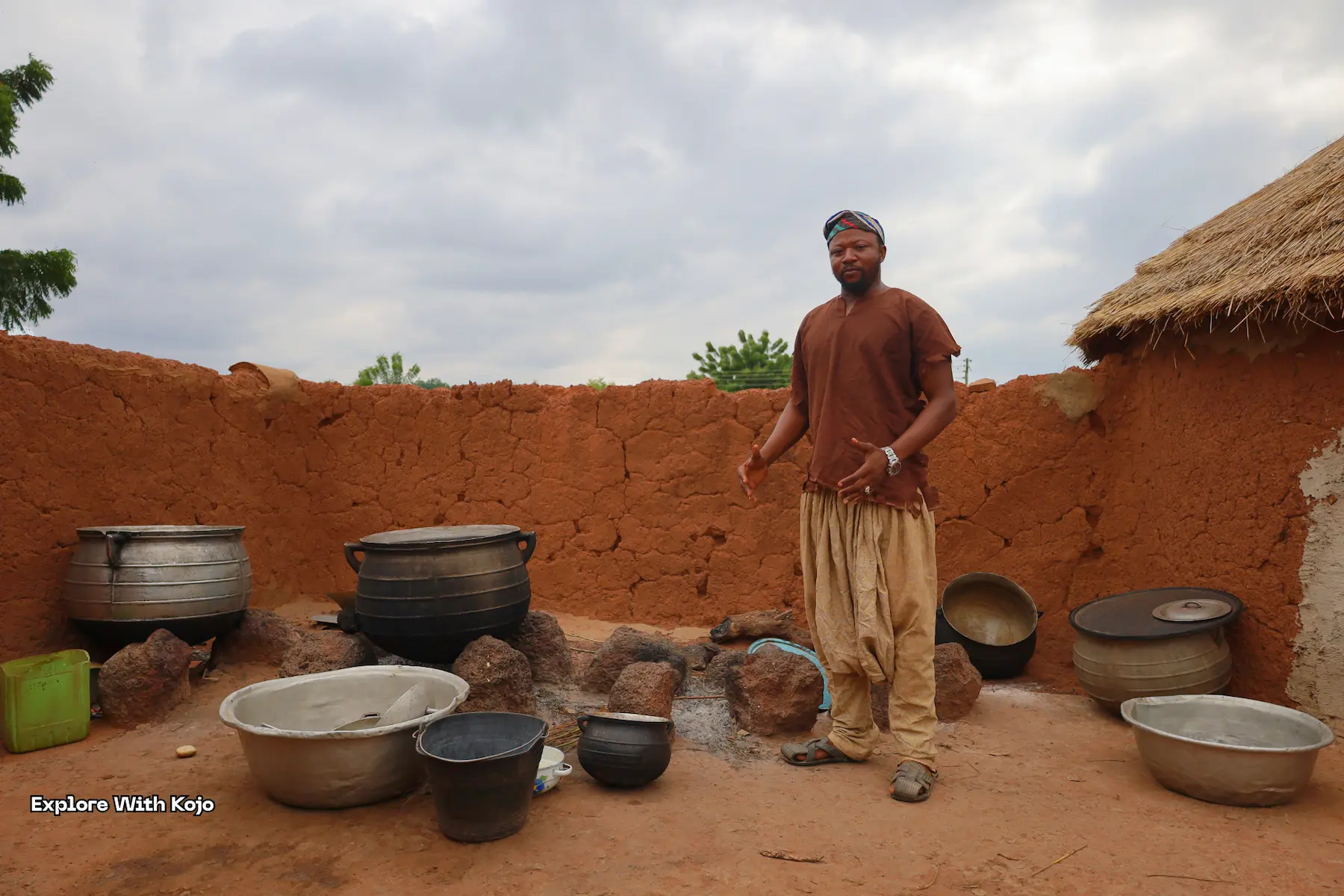
Lawrence prepares African black soap, pouring the batch out to cool and dry before molding. Photo: Explore With Kojo.
“After some time, you’ll notice it starts to become solid. When it gets hard, that means it’s ready to be taken off the fire. You let it cool first. We have what we call a ‘frying pot’ that we use again. That’s where we re-melt the solid black soap to finish it off.”
Color is controlled by heat, Lawrence explained.
“Sometimes, if you want the soap to be darker, that’s when you increase the fire. When the fire is too high, you’ll notice the color of the soap changing to dark. But if you don’t want it too dark, then you reduce the fire to a level that keeps the color lighter.”
To keep grit out, they carefully strain and cool the soap using airflow before packaging.
“You don’t want any stones or particles getting into the soap. So we let air pass through it to help it cool down. After that, we use a silver bowl to collect everything, and then the packaging begins.”
Sizes and packaging
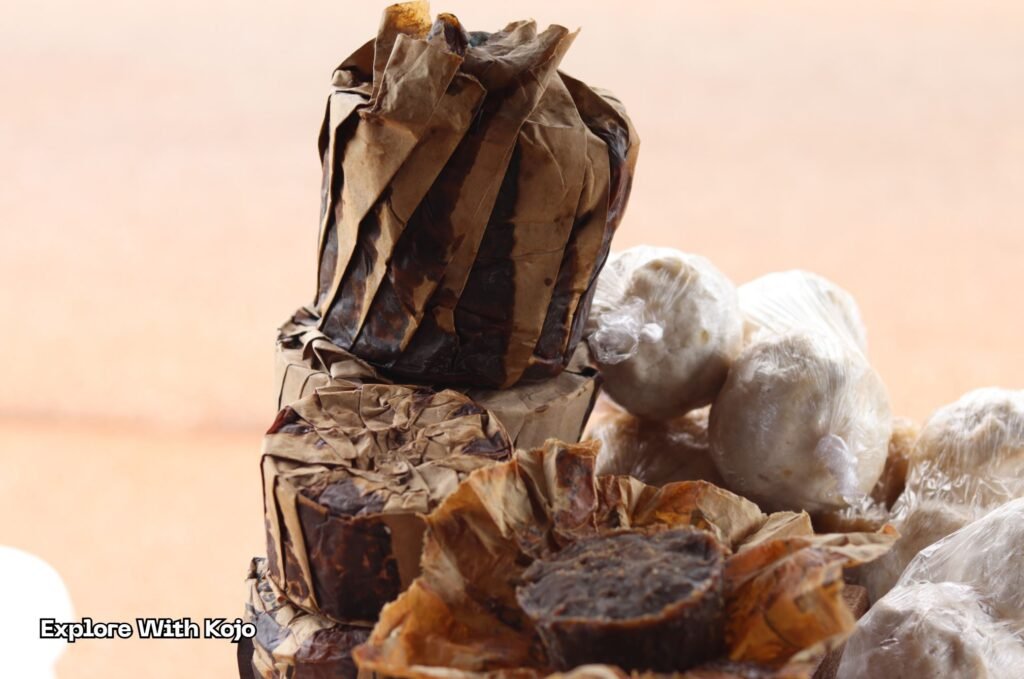
Black soap is sold either molded or in a crumbled form, often called the powdered version, depending on how you plan to use it.
“We have it in different sizes – 1 kilogram, 500 grams, 250 grams, 150 grams, and 120 grams,” he explained. “We also package the powdered one. Others prefer it in bulk, so we bag it in large sacks – sometimes up to 50 kilograms.”
Benefits people report
Many people love African black soap because it’s gentle, natural, and entirely plant-based. Lawrence pointed out three common benefits his customers often mention.
“It repairs the skin, prevents rashes, and nourishes the body,” he explained. “You know, it has shea butter – and it also helps remove body odor because of the potash.”
He was also quick to clarify that black soap is not a bleaching product.
“It actually brings out your beauty – your natural color,” he said with emphasis. “Are you getting it? It brings out your natural color.”
Price and certification

In terms of the pricing 1GK of the African Soap is currently sold at Gh 51.87 Ghana cedis and equivalent of $4.2. Although foreign Soaps are dominated in the Ghanaian market and in high demand because of the cheap price, which puts it in high demand compared to African Black Soap.
I asked Lawrence whether Sooglu’s products have gone through local regulatory checks.
“Yes, they’re certified by the FDA,” he said proudly. “We’ve been given the official stamp of approval and a certificate as well.”
Demand in Ghana and abroad
Foreign soaps dominate supermarket shelves because all over Ghana because they are cheap and heavily marketed. But Lawrence says he is seeing strong local interest in traditional soap for one key reason:
“The Ghanaians have come to realize that it’s time for them to go back to what their forefathers taught them, which is the black soup. Because the foreign ones, majority of them has chemicals. But as you can see, these local soaps are chemical free. And that is why people cherish the black soap more than the foreign ones.”
While Sooglu does not yet ship directly overseas, Lawrence said many of their customers buy in bulk and handle exports themselves.
“For us, we haven’t started exporting yet,” he explained, “but many people buy from us and export it on their own. If we ever have a large quantity ready for export, they help us handle it.”
Any side effects of using the African Black Soap?
When asked about possible side effects, he was confident in his response.
“It doesn’t have any side effects,” he said. “Maybe the only side effect is when you buy it and don’t use it,” he added with a laugh. “It has all the properties the skin needs.”
A Note to You, the Traveler

If you’re coming to Africa from America, Europe, or Asia, here’s my honest, on-the-ground take. Black soap might seem like a souvenir but it’s part of daily life where I’m from. On market mornings in Ghana, aunties stack molded bars on cement-bag paper beside shea butter, and someone is always bargaining two stalls down. When you buy a bar here, you’re stepping into that rhythm.
Where I actually find them
- Big city markets: Accra (Makola), Kumasi (Kejetia), Tamale Main Market
- Smaller towns: any busy market day—ask by the local names first
- Best time: morning, when the freshest batches hit the table
How I buy (the way we do it)
- Start small: I’ll take a mini molded piece or a scoop of the crumbled version to test first
- Authenticity check: earthy brown tones (not jet-black), roasted/mineral smell, simple ingredients
- Respect: greet properly, smile, and always ask before you take photos since this is someone’s livelihood
My quick packing rules
- Solid soap is carry-on friendly
- I double-wrap it (paper + zip bag) so the scent doesn’t perfume my clothes
- If you’re carrying many bars home, check your customs rules. Don’t let a good market day end with trouble at the airport
If you go (my short checklist)
- Ask for: Alata Samina / Anago / African Black Soap or “Tolon Banku” for the white bar
- Time it: morning market hours are kinder on your wallet and your patience
- Look for: natural color, simple ingredients, that classic kraft/cement-bag wrap
- On the road: keep it dry between uses and stash extra slices for later





1 Response
[…] a production manager at Suglo Enterprise, known across Northern Ghana for producing authentic African black soap using time-honored techniques. He kindly invited me to his production site – and what […]