
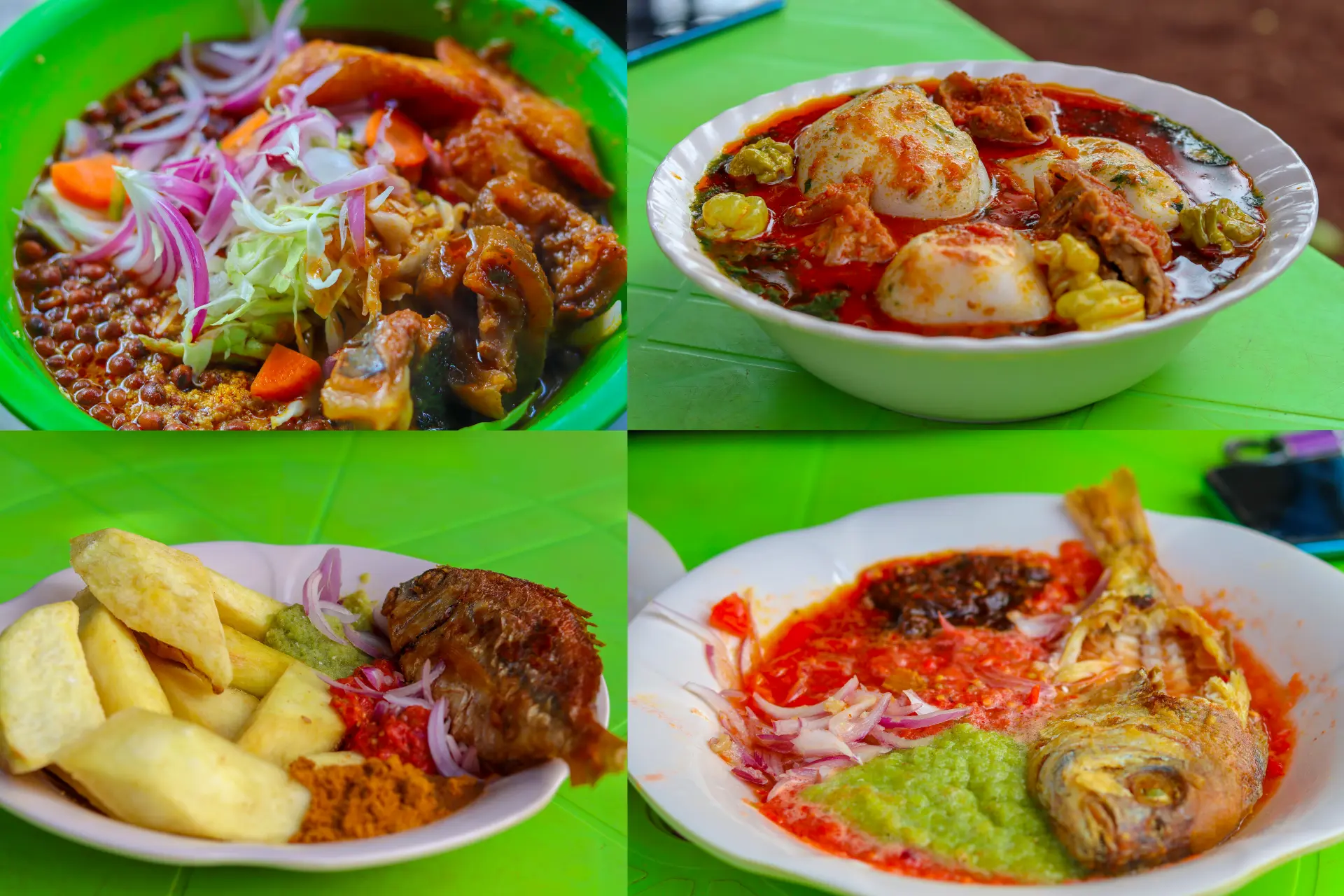
Top Must-Try Local Dishes in Ghana (With Prices and Photos)
If there’s one thing Ghana never runs out of, I’d say it’s definitely flavor. Everywhere you go, the aroma of food fills the air, from the smoky roadside grills to the small wooden kitchens tucked behind family homes. My team and I recently hit the streets to experience that flavor for ourselves and to taste some of Ghana’s most iconic local dishes. These are the kinds of meals you’ll find bubbling in big aluminum pots, wrapped carefully in plantain leaves, or served hot and fresh at small family-run joints. So without any further ado, let’s take a look at the top Ghanaian foods you absolutely have to try.
1. Aduwa (Cowpea Dish with Fried Plantain)

A steaming bowl of Aduwa, Ghana’s flavorful cowpea dish topped with fried plantain, onions, and cabbage.
The first food we tried was Aduwa, a simple yet surprisingly rich cowpea dish that many Ghanaians love. We found it being served hot in a small and lively food spot, the kind of place where the air is filled with the smell of fried plantain and spicy sauce.
Aduwa is made from boiled cowpeas, also known as black-eyed beans, and is usually served with fried plantains, onions, cabbage, and sometimes a little palm oil or gari to enhance the flavor. It is one of those meals that looks modest but tastes like pure comfort. Every spoonful is hearty, flavorful, and deeply satisfying.
Aduwa is also one of the staple foods in Tamale, though not very common in other parts of Ghana. It is a boiled cowpea dish enjoyed with plantain, gari, vegetables, and often beef, wele (cow skin), or any added protein. You can think of it as northern Ghana’s version of Gobe (beans and gari). It is affordable too. For example, for around 10 Ghana cedis, you can get a generous plate with all the toppings and protein.
What stood out to me was how perfectly balanced the dish felt. The sweetness of the plantain, the soft beans, and the slight crunch of the onions and cabbage all blended beautifully. It is not a complicated meal, but that is exactly what makes it special.
If you ever visit Ghana, especially the northern regions, make sure to try Aduwa. It is wholesome and very delicious. And it is without a shred of doubt one of those local foods that gives you a true taste of everyday Ghanaian life.
2. Tubaani (Steamed Bean Cake)

This is tubaani, Ghana’s traditional steamed bean cake.
Next on our list was Tubaani, one of Northern Ghana’s most traditional dishes. It is made from black-eyed beans that are first soaked and then ground before being steamed to form a soft, cake-like texture. The process might sound simple, but the result is rich in flavor and full of protein.
We met a local vendor who served it hot from the pot, with the steam still rising through the leaves it was cooked in. Dan, one of our team members, couldn’t wait to dig in. You can actually see him in the photo enjoying a fresh serving right by the roadside. The look on his face says it all.

Dan enjoying a bite of freshly made tubaani.
Tubaani is often paired with spicy pepper sauce and sometimes garnished with onions or fried fish. The texture is firm but smooth, and the taste is mild, allowing the pepper and sauce to do the talking. It’s the kind of food that feels homemade, even when eaten outdoors.
There is also a popular variation known as Tuubani with “Bungu” and Wele (cow skin). This version is made using Bambara bean flour, molded in leaves, and cooked under steam. It is typically enjoyed with ground sesame seeds called Bungu in Dagbani, along with groundnut paste residue, shea butter oil, and sliced onions. Many locals also add soft, chewy pieces of cooked cow skin known as Wele.
A single slice of Tuubani costs about 1 Ghana cedi, while Wele is also about 1 cedi. For roughly 15 Ghana cedis, you can get a full, satisfying portion that will keep you full for hours. Interestingly, Tuubani is not very common in Accra, which makes it a little difficult to find and more expensive there (usually between 25 and 30 cedis for the same portion you’d get much cheaper in Tamale).
In many ways, Tubaani represents the heart of Northern Ghanaian cooking. It is very healthy and affordable, and of course delicious too. If you ever visit the northern part of Ghana, make sure to try it fresh from a local vendor.
3. Banku with Fish and Pepper Sauce

Banku, fish, and mixed pepper sauces.
After Tubaani, we went for one of Ghana’s most loved dishes, Banku with fish and pepper sauce. It is a meal you can find almost anywhere in the country, from small food joints in fishing communities to busy city corners in Accra.
Banku with grinded pepper and fish is popularly known as a quick fix. Banku is made from corn dough and cassava dough. The corn dough is prepared from maize that is soaked for three days or sometimes up to a week, then ground into a smooth paste. The cassava dough is also soaked and ground before being mixed with the corn dough. These two ingredients are then cooked together while being stirred continuously until they become thick and starchy.

A local diner savoring banku and fish the traditional Ghanaian way with the hands.
Banku is commonly eaten with grinded pepper, sliced onions, and fried or grilled fish. The pepper is usually mixed fresh, giving the dish a bold and spicy flavor that perfectly complements the slight sourness of the banku.
In Tamale, a ball of banku costs around 5 Ghana cedis, and fried fish ranges from 5 to 20 cedis depending on the size. With about 25 to 35 cedis, you can get a full meal that will leave you completely satisfied. In Accra, however, you might pay between 45 and 60 cedis for the same portion.
4. Fried Yam with Fish and Pepper or Yaji

Crispy fried fish with yam and local pepper, a simple but iconic Ghanaian meal.
Next, we went for something simple but truly iconic, fried yam with fish and pepper. This is one of Ghana’s most common street foods and a true favorite among people looking for a quick, tasty meal. It is often considered a quick fix because all you need to do is peel a tuber of yam, cut it into pieces, fry them in oil, and enjoy it with “Yaji” and any protein, though most people prefer fried fish.
Yaji is a flavorful spice mix made with roasted peanuts, garlic powder, onion, and salt, all ground together into a fine powder. Interestingly, the word Yaji comes from the Hausa language, and it means “spices”. It is widely used in Nigeria for seasoning roasted beef, but in Northern Ghana, it has found its way onto plates of fried yam.
The yams themselves are fried until golden and crispy outside while remaining soft inside. They are served with spicy red and green pepper sauces, thinly sliced onions, and a generous dusting of Yaji. The combination is something else!
In Tamale, a piece of fried yam costs about 1 Ghana cedi, while fried fish goes for around 5 to 20 cedis, depending on size. The Yaji usually comes free with the meal. So, with about 20 Ghana cedis, you can enjoy a full and satisfying portion. In Accra, though, you might spend between 30 and 40 cedis for the same meal.
5. Fufu and Soup

Classic Ghanaian fufu served in rich palm nut soup with tender meat and chilies.
No Ghanaian food journey is complete without fufu and soup. It is one of the country’s most iconic dishes, which you will find in abundance in all parts of the country. Fufu is made by pounding boiled cassava and plantain (or cassava) together until it becomes smooth and slightly sticky. It takes time and effort to prepare, but that is part of what makes it so special.
In Ghana, fufu is usually served with different types of soup, the most popular being palm nut soup and light soup. Both soups are often served with tender pieces of meat, goat, fish, or chicken.
When our bowl arrived, the color of the soup alone was enough to make us pause. The deep red broth shimmered under the light, and the aroma filled the air. It is the kind of meal that slows everything down. You do not rush fufu. You take your time and enjoy it bite by bite, traditionally with your hands.

Getting ready to enjoy fufu and palm nut soup the traditional way.
Dan also gave it a try. Fufu with palm nut soup happens to be his favorite meal, and he couldn’t hide the excitement on his face as he scooped his first handful.
In Tamale, a plate of fufu with meat or fish costs around 20 to 25 Ghana cedis, while in Accra, you can expect to pay between 45 and 75 cedis depending on the location. Most people eat it in the afternoon or evening when they have enough time to relax afterward because, let’s be honest, fufu fills you up fast.
6. Kenkey with Fish and Pepper Sauce

Ghana’s famous kenkey served with spicy sauces and fried fish.
Our next stop was for another Ghanaian classic, Kenkey with fish and pepper sauce. This dish is one of the country’s most famous and beloved meals, especially among coastal communities.
Kenkey is made from fermented corn dough that is wrapped tightly in dried corn husks and boiled for several hours. The fermentation gives it a slightly sour taste (almost like that of banku). And this taste blends perfectly with the spicy sauces that usually come with it. When paired with fried fish, sliced onions, and a mix of red, green, and black pepper sauces, the combination is unbeatable.
We found a small roadside vendor serving kenkey that was soft, warm, and fresh out of the pot. The smell of the fried fish alone was enough to make us stop and order.

Enjoying Ghana’s favorite combo of kenkey, fried fish, and spicy pepper sauce.
A ball of kenkey in Tamale costs about 5 Ghana cedis, while the fried fish ranges between 10 and 20 cedis, depending on size. You can also find larger combos that go for around 25 to 30 cedis, enough to satisfy even the biggest appetite. In Accra, prices are a little higher, often between 35 and 45 cedis for the same serving.
7. Tuo Zaafi (TZ)

A local Ghanaian enjoying a delicious bowl of tuo zaafi by the roadside.
For our next meal, we decided to go for something truly northern, Tuo Zaafi, often called TZ. This is one of the most loved dishes in Tamale and across Northern Ghana. The name Tuwo Zaafi comes from Hausa and it means hot food.
TZ is made from ground maize that is turned into flour and cooked into a smooth, starchy compound. It can be eaten with many different soups, but it is most commonly served with Ayoyo soup, a green leafy soup made from jute leaves. The mix of the soft TZ with the slightly slippery Ayoyo soup creates a beautiful texture that northern Ghanaians know and love.
Samed, one of our team members and the primary writer of this article, could not wait to have his share. As a proud northerner, this was one of his favorite dishes, and it showed. The moment the plate arrived with its colorful mix of red and green soups, he dug in happily by hand, savoring each bite with a satisfied grin.

Samed enjoying his bowl of tuo zaafi.
In Tamale, a full serving of TZ costs around 25 Ghana cedis, with 15 cedis for the TZ itself and 10 cedis for the beef or goat meat. That is more than enough to leave you full. In Accra and other parts of the country, though, the same meal will cost between 40 and 50 cedis.
For anyone visiting Northern Ghana or any part of Ghana, this is definitely one dish you cannot leave without trying.
8. Wasa Wasa

Wasawasa served with fried fish, boiled egg, and salad greens.
Our food adventure continued with Wasa Wasa, which is another beloved northern Ghanaian dish that deserves more attention than it gets. Made from dried yam flour, Wasa Wasa has a distinct earthy flavor and a grainy texture that sets it apart from most other Ghanaian meals. It is especially popular in Tamale and other parts of Northern Ghana, where it is enjoyed at home and sold at local food joints.
The yam flour is first steamed until it forms soft, separate grains that resemble couscous. It is then served with fried fish and boiled egg. Sometimes you can add a few slices of wele (cow skin), all topped with spicy tomato sauce and pepper. The plate is often garnished with salad greens or onions to add freshness to the meal.
In most parts of Ghana, you can get a satisfying plate of Wasa Wasa for about 20 to 35 Ghana cedis, depending on the size of the fish and toppings you choose. In bigger cities like Accra, the same meal would cost around between 40 and 5 cedis.
9. Roasted Corn with Fresh Coconut

Roasted corn with fresh coconut, a perfect Ghanaian street combo.
Another everyday Ghanaian favorite is roasted corn with fresh coconut. You will spot grills on busy streets all afternoon, the air rich with that smoky, sweet aroma. The corn is charred for a light crunch, then you follow each bite with a cool slice of coconut. Simple, refreshing, and perfect for snacking as you explore.

Enjoying roasted corn the Ghanaian way, fresh off the grill.
That is Samed in the photo enjoying his corn straight off the grill. He says the slightly blackened kernels carry the most flavor. The warm corn and cold coconut make a pairing that never gets old.
It is sold by the piece, so it is easy to buy just enough for the moment or share with friends. If you want a quick local snack, this is a great place to start.
10. Waakye

A rich plate of Ghanaian waakye with fish, egg, shito, and fresh salad.
No Ghanaian food journey is complete without waakye, the country’s beloved rice and beans dish. It’s one of those meals you can smell before you even see it. In the photo, you can see a rich serving of waakye topped with spaghetti, gari, and a generous scoop of shito. Shito is the black pepper sauce that ties everything together.
Waakye is originally a northern dish but has become a national favorite enjoyed from Accra to Tamale. The rice is cooked with dried sorghum leaves, which give it its signature brown color and earthy taste. Traditionally, it’s served with fried plantain, wele, salad, boiled egg, and sometimes even spaghetti for a little extra filling.
In Tamale, a good portion of waakye with fish, egg, and shito costs about 20 to 25 Ghana cedis, depending on what extras you add. In Accra, however, the same plate could cost around 50 cedis. Most locals prefer to eat it by hand, just like in the second photo, where the experience feels more authentic and satisfying.

Enjoying waakye the traditional way, eaten by hand.
Roasted Plantain with Peanuts (Kofi Brokeman)

Roasted plantains served with groundnuts, a street snack Ghanaians call Kofi Brokeman.
There’s something special about roasted plantains in Ghana. The smell alone can stop you in your tracks. Popularly known as Kofi Brokeman, this street food is often called the poor man’s meal, but it’s loved by everyone. Peeled and roasted plantain served with peanuts is something you’ll find anywhere in Ghana, from Tamale to Accra. One portion costs about GH₵5 in Tamale and the same in Accra. It may not fill you up for long, but it keeps you going, and sometimes that’s all you need.

Freshly roasted plantains being served straight from the grill in Ghana, a favorite local snack.
I captured this moment right at the grill as roasted plantains were being handed over to a customer.
Jollof Rice

A full plate of Ghanaian jollof rice topped with egg, salad, and spaghetti, a local favorite.
Nothing brings people together in Ghana quite like jollof rice. This is one of Ghana’s food signatures, and it has sparked a friendly but fiery rivalry with Nigeria over who makes it best. Jollof is rice cooked together with a rich tomato stew and enjoyed with vegetables and any protein. In Tamale, a plate of jollof costs about GH₵25 and is enough to get you full, while in Accra, you might pay GH₵45 or GH₵50 for the same.

Enjoying a plate of Ghana jollof rice.
This plate of Ghana jollof tells its own story. The rich tomato color, the texture of the rice, and the boiled egg on top make it a perfect mix of flavor and pride. The thing about jollof here is that very cook believes theirs is the best, and every version somehow tastes like home.
Kosua Ne Meko (Boiled Egg with Grinded Pepper)

Salted boiled eggs in Ghana, a simple but popular snack often sold at markets and bus stations.
I took this photo in Ghana where boiled eggs coated in salt are one of the simplest yet most satisfying street snacks you can find. They’re often sold fresh at markets or bus stations and usually enjoyed with spicy pepper. It’s simple, affordable, and always hits the spot.

Ghanaian street food kosua ne meko, boiled Kosua ne meko is a simple but fiery Ghanaian street snack made of boiled egg with pepper sauce.
Kosua ne meko, or boiled egg with pepper, is believed to have originated from the Ashanti region, which explains the Akan name. But today, it’s enjoyed everywhere in Ghana, including Tamale. One boiled egg with pepper costs about GH₵3 in Tamale. It’s not a full meal but enough to keep you going. You’ll often hear women walking through town carrying trays of eggs and shouting, “Kosuaaaaaa! Ne Meko!”
Sobolobo (Hibiscus Drink)

Sobolo, Ghana’s deep red hibiscus drink, known for its tangy taste and vibrant color.
Sobolobo, also known as Sobolo, is one of Ghana’s most loved drinks, especially in Tamale. Made from dried hibiscus leaves boiled with ginger and other spices, it’s tangy, refreshing, and full of color. A bottle of Sobolobo costs about GH₵5 in Tamale. It tastes great and is also believed to have some health benefits.
This cup and bottle of Sobolo caught my eye right after a meal. The color was so deep and beautiful that I had to photograph it. Every sip has a perfect mix of sweetness, spice, and floral notes.
Zimkom (Pear Millet Drink)

Zimkom, a traditional Ghanaian ginger drink served in a calabash bowl.
Zimkom is a popular beverage in Tamale made from pear millet flour mixed with ginger, sweeteners, and spices. The name “Zimkom” in Dagbani means “flour water.” It’s strong, spicy, and surprisingly energizing. A bottle costs about GH₵5 in Tamale, and it’s common to see women carrying bottles of it through the streets, selling to both locals and travelers.
Here, Zimkom is served the traditional way, in a calabash. There’s something earthy about drinking it like this, it feels close to the culture. The ginger flavor is sharp and authentic, and many people believe it helps with digestion and cooling the body.

Three glasses of zimkom ready to serve, a fiery ginger drink loved across Ghana.
I took this photo at a small local spot where Zimkom is served chilled in glasses. The foam on top says it all, freshly mixed and full of life. It’s simple, traditional, and found everywhere from family homes to market corners.
Hausa Koko and Koose

A popular Ghanaian breakfast made with spicy Hausa koko porridge served with crispy koose bean cakes.
Koko and Koose is the most popular breakfast in northern Ghana, especially in Tamale. Koko is made from millet dough and flavored with ginger and cloves, while Koose is made from beans flour and fried to perfection. A bowl of Koko costs about GH₵3 and a piece of Koose is GH₵5 in Tamale. Together, they make the perfect start to the day.

Breakfast in Ghana means enjoying a bowl of Hausa koko with freshly fried koose.
I captured this during breakfast time in Ghana, Koko and Koose again, but this time through the expression of someone truly enjoying it. You can almost feel the warmth in the image. It’s not a fancy meal, but it’s a deeply loved one, part of the everyday rhythm of life in the north.
Burkina (Millet Drink)

Burkina, a chilled Ghanaian drink made from millet and yogurt, loved for its smooth and refreshing taste.
Burkina is a popular Ghanaian beverage made from ground millet mixed with fresh or fermented milk, sometimes with sugar, yogurt, and a touch of ginger or spice. It’s nutritious, smooth, and filling, often sold by street vendors in bottles. The millet is ground, rolled into tiny balls, and mixed with milk to create a rich, creamy texture. A bottle of Burkina costs GH₵5 in Tamale, and it’s enough to quench your thirst and satisfy your hunger at once.