The Grand Palace Bangkok Guide: Tickets, Dress Code, Rules & Tips (2025)
As we recently highlighted on Explore With Kojo, Thailand is a country that attracts an inordinate amount of adult oriented tourism. But there’s a lot more to this Southeast Asian nation than that which appeals to johns. For instance, most readers may not know that the Land of Smiles is one of the few places where a constitutional monarchy is practiced. The people have an active, respected and well-known king, who descended from royal lineage, though he doesn’t have that type of Old World power to do whatever he wants anymore.
The significance that fact holds in relation to tourism is that the Thai royal palace, from the days of old, is still very much extant. Located in the capital city of Bangkok, it no longer serves the purpose of housing the royal family, and these days it has limited governmental significance. However the Grand Palace, as it’s called, has been immaculately maintained and edified throughout the centuries.
The fact that the Thai care so much about this facility illustrates the reverence and prestige the royal family retains, even after losing absolute power a long time ago. Nowadays, as far as us tourists are concerned, the Grand Palace serves primarily as a tourist attraction, usually holding down the top spot of must-see sites in Thailand.
BRIEF HISTORY OF THE GRAND PALACE
The existence of the Grand Palace dates all the way back to 1782, when Thailand was rather known as Siam. Remember “Si and Am”, the Siamese cats from Disney’s Lady and the Tramp? That’s actually a reference to Thailand.
But going back to the Grand Palace, it served as the Siam/Thai king’s official residence, besides housing his government and family. Earlier in the 20th century, the Thai started building additional, more modernized palaces to serve those purposes. But some of the royals’ ceremonial and official functions are still performed at the Grand Palace, besides the site, as mentioned earlier, being of major tourism significance. Furthermore, the compound houses what is generally regarded as the most-sacred temple in this country.
WHAT IS THE GRAND PALACE CURRENTLY USED FOR?
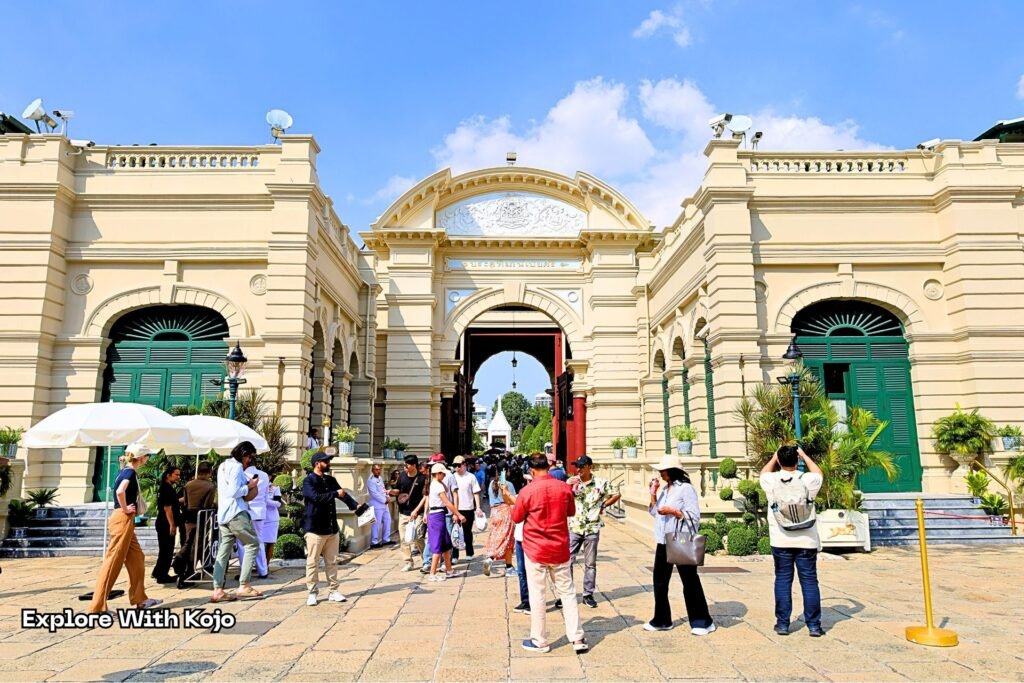
Part of the courtyard of The Grand Palace that leads to the exit.
Some of the monarchy’s offices are located at the Grand Palace, being housed in structures that can be classified as architectural marvels. That’s besides the more breathtaking Temple of the Emerald Buddha. It can be said that symbolically, the Grand Palace stands at the center of Thai politics and religiosity as far as the royals are concerned. As such, many of the nation’s holidays are celebrated and recognized here, in style.
Besides its impressive infrastructure and convenient location, it’s the Grand Palace’s standing as a ceremonial hotspot which also contributes to it being the top tourism attraction in Thailand. The idea of venturing to Bangkok without visiting the Grand Palace is an absolute no-no. We may all have our own individual reasons for wanting to come to Thailand.
But if you want to see the best that Thai tradition has to offer and if you’re in Bangkok for any longer than a single day, then you have to hit up the Grand Palace. Heat, scammers and other distractions aside, I have yet to come across anyone who has regretted visiting this site, if for no other reason than appreciating the architecture and world-class decorations alone. And as a student of Thai history and culture, there’s also a lot you can learn here.
TYPES OF CEREMONIES HELD AT THE GRAND PALACE
Rice is an important crop in Thailand – so much so that there’s a holiday observed upon the (traditional) onset of rice-growing season. This event is called the Royal Ploughing Ceremony. And as its name sorta implies, it kicks off at the Grand Palace, usually circa early May.
Loy Krathong, sometimes referred to as Thailand’s “Festival of Lights”, is actually a regional holiday, and it is most often celebrated in November. The standard is for this festival to be observed at waterbodies, such as rivers and lakes. But the royals also recognize it by pimping the Grand Palace out with lights and other decorations that time of year.
GRAND PALACE’S DRESS CODE
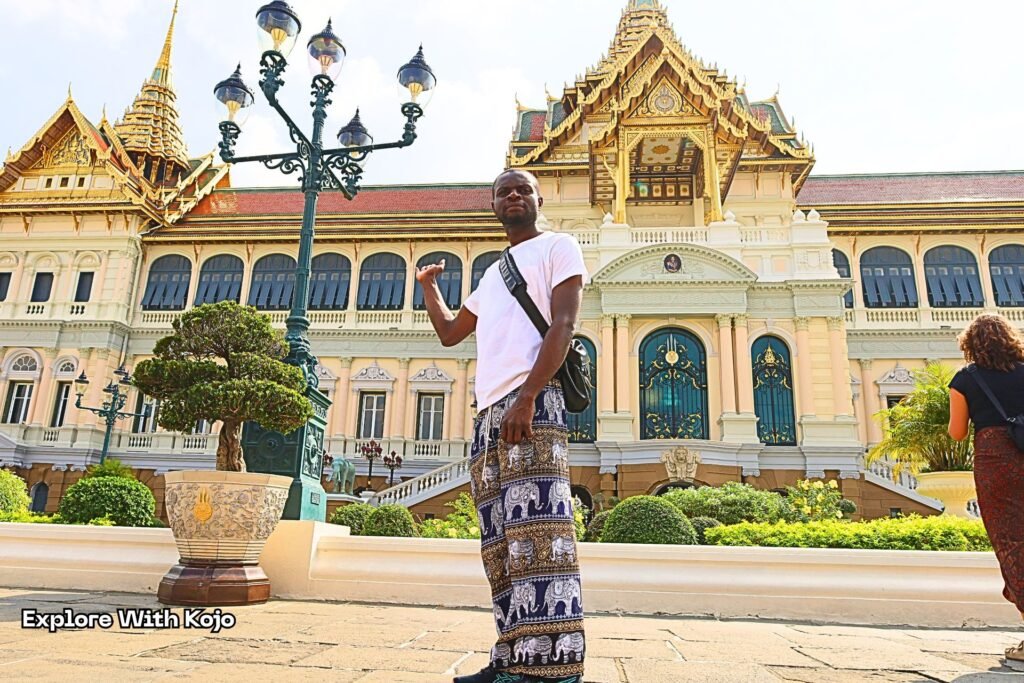
Yes, that’s me standing in front of the Grand Palace.
Thailand has “morality laws” which the country takes seriously. These statutes aren’t repressive but for those of us who grew up in the West take some getting to. The average Thai is not going to step to you for, say, wearing short shorts (though they may gawk a bit). But just the fact that a nation has these types of standards should let you know that these people, including the authorities, are more aware of how you carry yourself. And this is especially true in the Grand Palace.
The Grand Palace isn’t just a castle, if you will. In its entirety, the complex spans a whopping 60 acres, enclosed behind a wall that encompasses the entire compound. It’s like a mini city, if you will. And besides museums and government offices, there’s also a major temple.
The Temple of the Emerald Buddha needs to be firmly acknowledged within the context of visiting the Grand Palace. The Temple of the Emerald Buddha is not only Thailand’s most-sacred Buddhist site but also the main attraction, by far, within the Grand Palace’s gates. This is arguably the one place in Thailand where the nation’s political inclinations most intersect with the peoples’ dominant religious beliefs.
So it should go without saying that the dress code inside the Grand Palace is even more stringent than those imposed outside. You can get away with wearing certain things outside that you shouldn’t even attempt rocking to the Grand Palace.
If you decide to wear a tank top, crop top, high shorts, see-through or loud clothing, etc., you can forget about being granted entry. A general rule of thumb is that if you think what you’re wearing is inappropriate, then it probably is.
DRESSING IN THAILAND
Let me be blunt and say that yes, dressing conservatively in a country like Thailand can be a real pain in the a*s. And this is especially true if you’re coming from a country where you’re allowed to wear what you want.
Most of us come to the tropics to enjoy the sun, not hide from it. But the good news is, you should be able to easily find affordable clothes which cover your ankles, knees, shoulders and torso that are light and airy enough to comfortably rock at the Grand Palace. As long as you’re not one of those people who prefer to walk around half naked, you should be okay in Thailand.
And wearing long clothes isn’t only about conforming to cultural norms. More practically, full-length apparel also serves the purpose of protecting your skin from the sun and mosquitoes.
Visiting any of the country’s temples usually requires foreigners to practice a higher level of modesty than when on the streets. And that’s especially true if it’s one of the nation’s top temples, like that of the Emerald Buddha.
HOW MUCH DOES IT COST AND WHEN TO GO
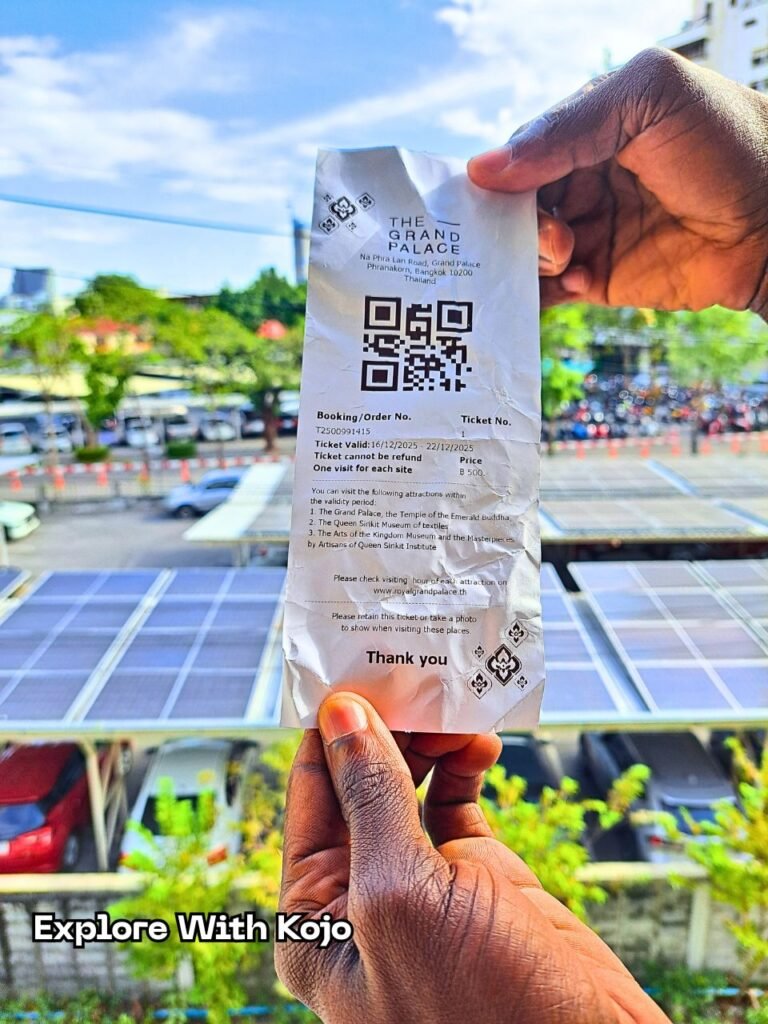
My official ticket to the Grand Palace. I paid 500 Baht for this.
As of the time of the writing of this piece, as a foreign adult visiting the Grand Palace you’ll be set back 500 Thai Baht or about $15. If you have a child with you who’s shorter than 120cm (i.e. 4 feet), he or she can get in for free.
The public does not have access to the entirety of the Grand Palace. But visiting the spots that are accessible – like the Temple of the Emerald Buddha and Queen Sirikit Museum of Textiles – is well worth the price of admission.
TRYING TO BEAT THE HEAT
The earlier you arrive at the Grand Palace, the better. Or maybe you can play the delay game by waiting until late in the afternoon, when hopefully crowds have dissipated, to make your entrance move. Either way, you wouldn’t want to get stuck in a long queue in the Thai heat. The Grand Palace is not only popular amongst tourists but also locals, who by the way are granted free access. Also concerning the heat, if this site is must-see on your itinerary – as it should be – then you’d perhaps want to visit Thailand around the New Year, when the weather is a bit cooler.
HOURS OF OPERATION
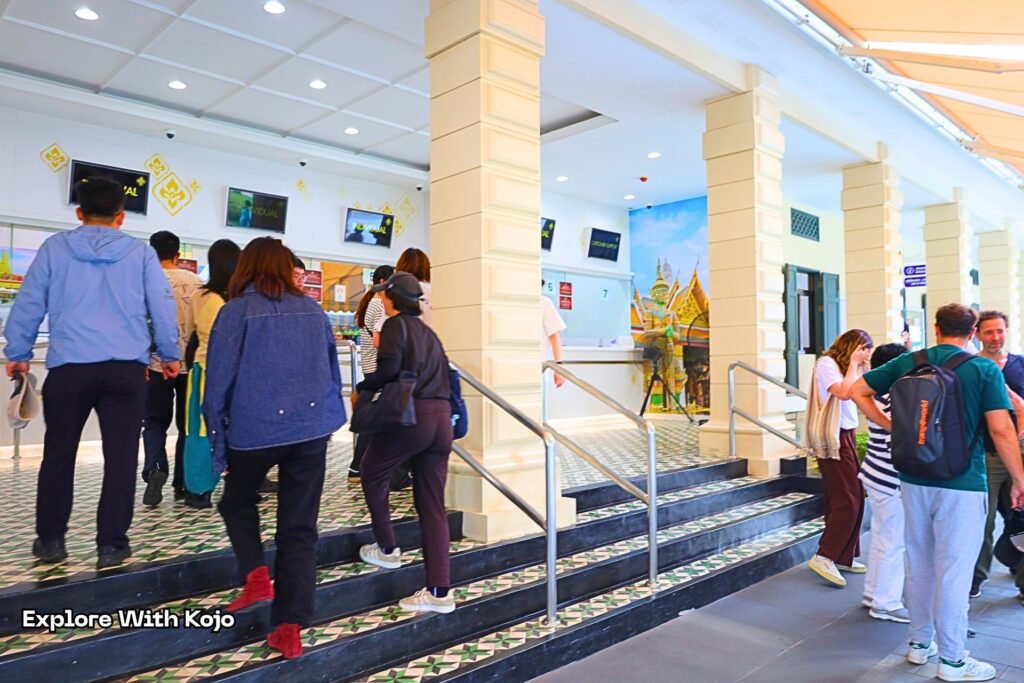
The ticket office. You can either purchase tickets via these booths or the vending machines just next to the booths. I bought my ticket from here.
The Grand Palace is only accessible for eight hours a day, from 8:30 to 4:30, and they stop letting people in an hour before closing. The good news is that it’s open most every day, even on weekends and holidays. However, the royals sometimes hold ceremonies which necessitate the palace closing its gates to the public. So if you plan on visiting but aren’t familiar with the Thai calendar – which fluctuates more than Western ones – then you can check the Grand Palace website for the upcoming schedule.
TOURIST SCAMS AND HOW TO AVOID THEM
There’s plenty of people out there in the world looking to make a quick, unethical buck, and Thailand is no different in that regard. Some visitors may even argue that Bangkok is akin to one of the global centers of petty scams. This country has a robust expat community, so I don’t want to make it sound like it isn’t safe for foreigners. But sometimes, you have to be on your Ps and Qs when interacting with the locals.
Since tourist a regular, more vulnerable and relatively well-paid sight in Bangkok, a lot of these scammers target us and victimize those who aren’t adept in the local system. And they’re even crafty enough to use our desire to visit the Grand Palace as a potential means of exploitation.
For instance, you may find someone scalping a ticket for admission. However, officially you can only buy tickets from the gate itself. So if you come across someone who’s trying to convince you otherwise, that tickets have to be bought before you get to the entrance, then they’re out to beat you in the head.
TRANSPORTATION TO THE GRAND PALACE
You won’t have a problem getting to the Grand Palace as transportation options go. It’s situated in a part of Bangkok that’s easily accessible by land or water. Central Bangkok is amazing from all angles, but I recommend taking the Chao Phraya River or the Skytrain to the Grand Palace, if you want to maximize your sightseeing experience.
Sometimes, the person transporting you may also try to take advantage of your relative naiveté. They may try to sell you a ticket or convince you to spend money in ways that you didn’t intend.
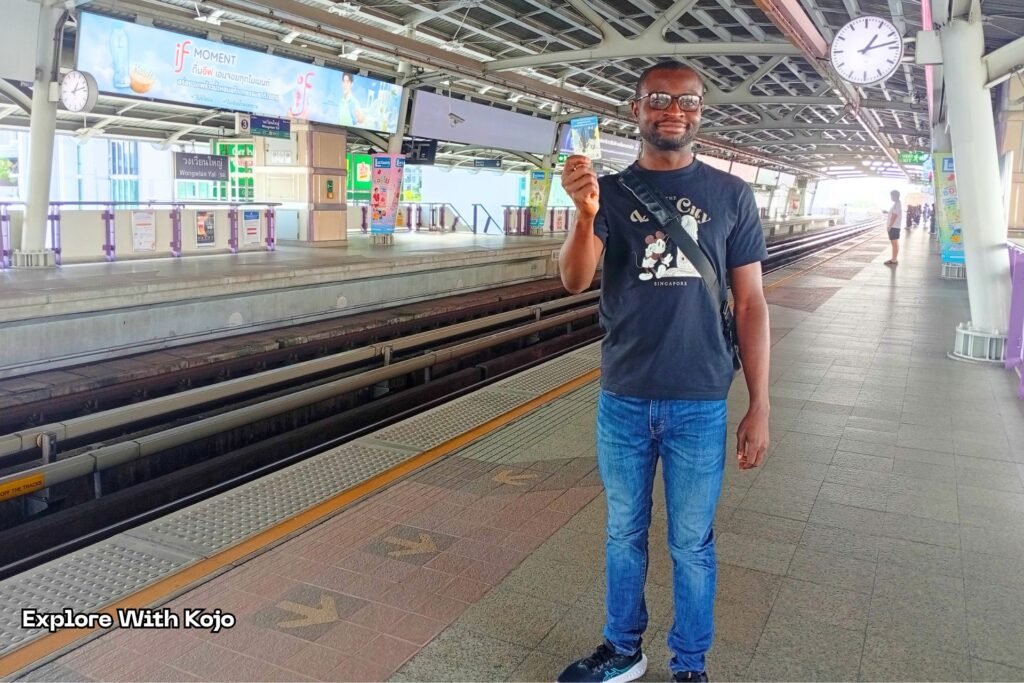
I prefer taking the train around Bangkok since it helps me beat the city’s crazy traffic.
If you’re a single traveler or one of those people who don’t know how to say no, then it may be preferable to visit the palace with an experienced companion or trustworthy tour guide. The problems aren’t inside the facility but with some of the people you may meet along the way.
These kinds of experiences aren’t unusual, if you’re a First World traveler visiting a poorer nation. Sometimes, you may interact with unethical hustlers and later laugh about it. It ends up being one of those experiences you can later tell the grandkids about. But other times, these shiesty characters may end up cheating you or otherwise ruining your experience.
PROTECT YOURSELF FROM SCAMS
Earlier, I recommended that you check the Grand Palace’s website’s scheduling before heading out there. This knowledge will not only prevent you from perhaps showing up on days it’s not open, but it’ll also safeguard you from being tricked into believing it’s closed when it’s not.
Yes, some scammers will try to con you into thinking that the Grand Palace isn’t operational at a time that it is. Some are even bold enough to do this right outside the palace’s gate or in the process of transporting you to the venue. The endgame? To convince you to follow them to another location – then perhaps another one and another one and another one – and in the process come up with increasingly-clever ways to gyp you. And if you’re naïve enough to go along with the game, in a worst-case scenario you may even find yourself being forcibly relieved of your valuables.
Having to deal with unscrupulous transporters is more or less a common part of the travel experience, regardless of where you go. Businesspeople that are overly eager to deal with foreigners from richer nations usually have ulterior motives in mind, taking advantage of the latter’s lack of understanding of how the local economy moves. Bangkok has more than enough individuals who operate along those lines.
There’s nothing wrong with paying a little bit extra, if you have it to spare. But doing so unknowingly or against your will can be frustrating or even criminal.
So in reality, even from the time you step out of your lodgings on the way to the Grand Palace, it’s good to be alert. Or if you have an opportunity, travel with someone who knows with time it is, unless you don’t mind perhaps interacting with a scammer or two.
IS THE GRAND PALACE WORTH THE VISIT, AND WHO IS IT GOOD FOR?
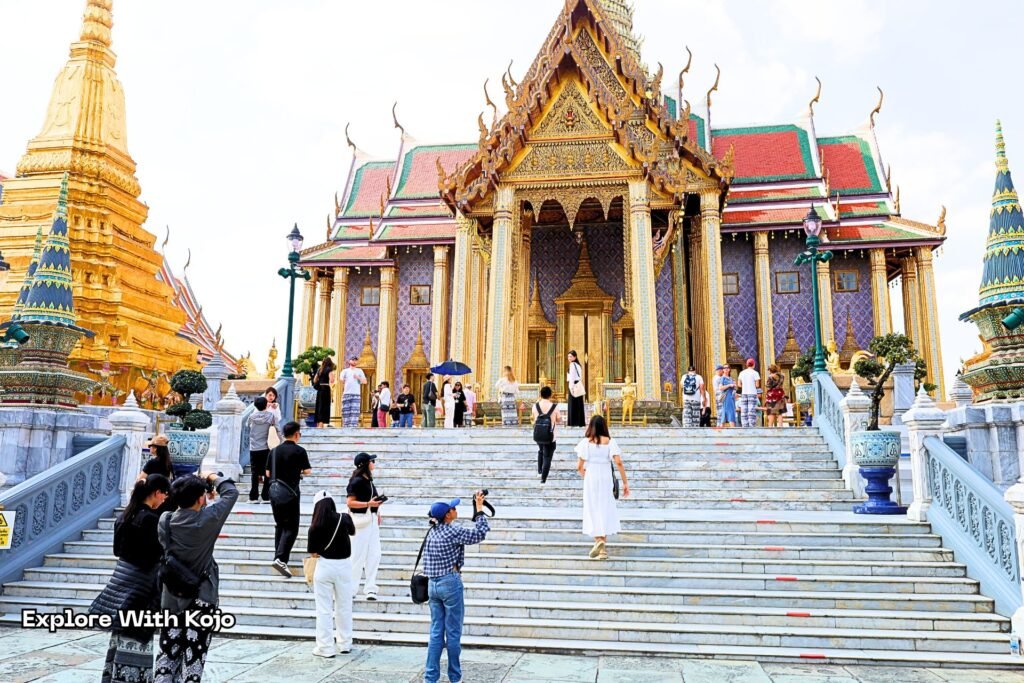
Going to Bangkok without visiting the Grand Palace would be like traveling to Washington D.C. without seeing the White House or heading to Paris and failing to behold the Eiffel Tower. Yes, there are plenty of other attractions around. But with tourists who’ve actually been to Bangkok, that’s likely the first place they’re going to ask if you’ve also been to.
As human beings, we appreciate both natural beauty and impressive manmade structures. And if you want to see some beautiful architectural marvels, the Grand Palace is one of the best places on Earth.
TRYING TO BEAT THE HEAT (PART 2)
That’s not to say that the experience is absolutely perfect. As far as I could see, there’s nothing wrong, at all, with how the Grand Palace is maintained. The concern rather is having to embark on a de facto fitness regime in the name of taking it all in.
While walking under the sun in the Grand Palace, the right side of my brain was like ‘wow, this place is amazing’. Meanwhile, the left was going ‘damn, it’s hot’. Traversing this huge facility in the Thai heat is not for the faint of heart. The Grand Palace is a pedestrian-only zone, meaning that there aren’t any vehicles to take patrons around. So it’s best to visit on days when you know you’re up for the challenge.
The good news is that there are precautions you can take against being adversely affected by the persistent heat. You can carry an umbrella, wear a hat or rock colors light enough to deflect sunlight.
And please, don’t let all this bitching about the heat deter you from visiting. In the grand scheme of the palace, the sun is just a tolerable, albeit persistent inconvenience. The big mistake I made was choosing my footwear based more on fashion than practicality. My feet felt like they were in a microwave, as I paid the price for not properly respecting the sun.
ACCESSIBILITY
If for whatever reason you’re not able to walk, the Grand Palace is fully wheelchair-accessible. This includes the site providing wheelchairs, without cost, to those who may need but not have one. I noticed that the grounds are also stroller-friendly, thus making it a nice place to bring the baby, though again, heat factors should be considered.
THE SFW TOURISM SIDE OF THAILAND
The Grand Palace is perfect for visitors to Thailand who are not just here for adult oriented services. I’m talking about those of us who actually want to learn something or are in the Land of Smiles with our families. And no, I’m not hating on anyone. What I’m saying is that the Grand Palace is an attraction that every tourist should take in, so long as you don’t mind wearing long clothes in the sun and paying proper respect at the site.
HURDLING THE LANGUAGE BARRIER
Thai is the official language of Thailand, but English is commonly recognized in places like Bangkok. This includes the Grand Palace, which has plenty of English-language signage. There are also affordable audio guides or apps you can patronize to direct you throughout the site in a number of different languages. And of course, there’s the option of actually hiring a tour guide or joining a tour group that is adept in English or the language of your homeland, if it’s a popular one.
ATTRACTIONS FOUND WITHIN THE GRAND PALACE
One way of looking at the Grand Palace is as an attraction which itself is made up of attractions. And on the top of that list is the Temple of the Emerald Buddha.
THE TEMPLE OF THE EMERALD BUDDHA
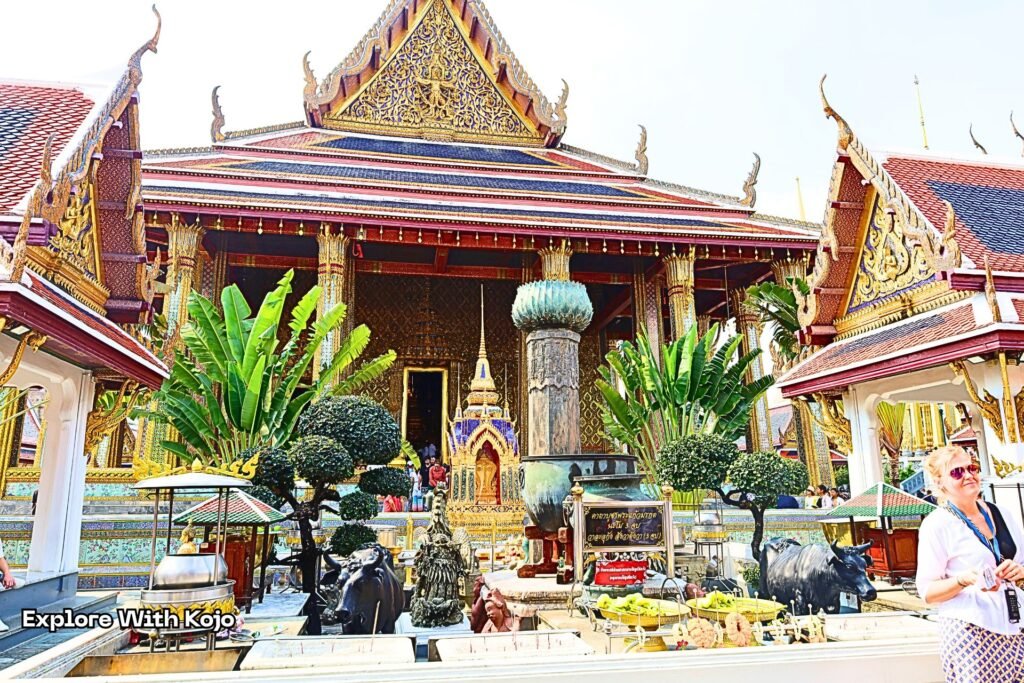
This is the altar located in front of the Temple of the Emerald Buddha.
This part of the compound is popular enough to attract visitors in and of itself. Amidst a modernized, tourist-accommodating Bangkok, the Temple of the Emerald Buddha is one of those places that’ll remind foreigners that they are in fact in a distinct part of the world.
The Grand Palace is, in its entirety, a perfect mixture of Thailand old and new. Most of the structures are very old but have been meticulously preserved into the present day.
Visitors are able to enter the temple and, if you’re lucky, even witness a Buddhist ceremony or two. However you won’t be posting those experiences on TikTok, as photography is restricted inside, as it is in some other sections of the Grand Palace.
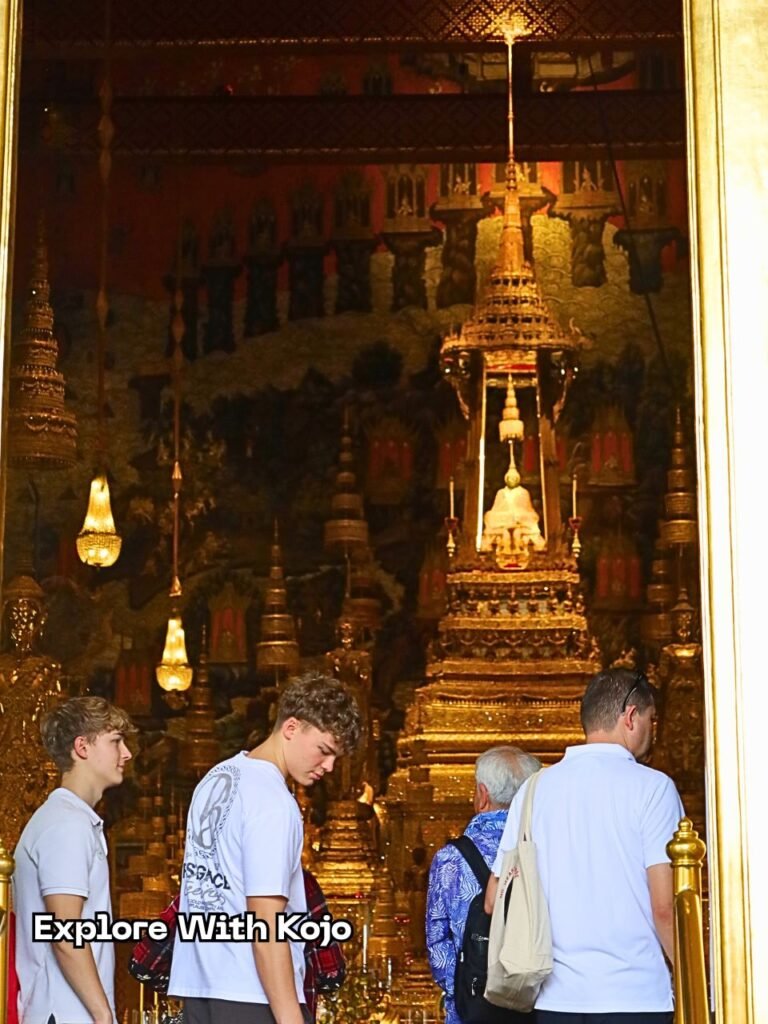
This is the Emerald Buddha. I took this photo from outside the temple since visitors aren’t allowed to take photos or film inside.
THE ROYAL COURTS
Visiting the royal courtyards, knowing that actual kings once lived and practiced here, fills me with a sense of awe and, dare I say it, opulence. As a king you’re expected to do it big, and those of Thailand weren’t afraid to spread themselves out so to speak.
As the story goes, each Thai monarch from the mid-18th century to today has made major contributions to the upkeep and furtherance of the Grand Palace. So another way of looking at this site is as being a giant (mostly architectural) museum that’s also been used for royal purposes. For instance, even though it no longer houses the hundreds of ladies (and children) that used to make up the royal household, just knowing that aspect of the history of the Inner Court makes you feel like you’re someplace special, being able to visit an area that was once completely cordoned off to us commoners.
And to this day who even knows – outside of Thai monarchs and high-ranking government officials – what all goes on inside of the Grand Palace. The Inner Court remains in large part closed to the public. And there are a number of (interior) sections of the Grand Palace that a ticket of admission does not grant you access to, besides what is and isn’t accessible fluctuating based on royal circumstances.
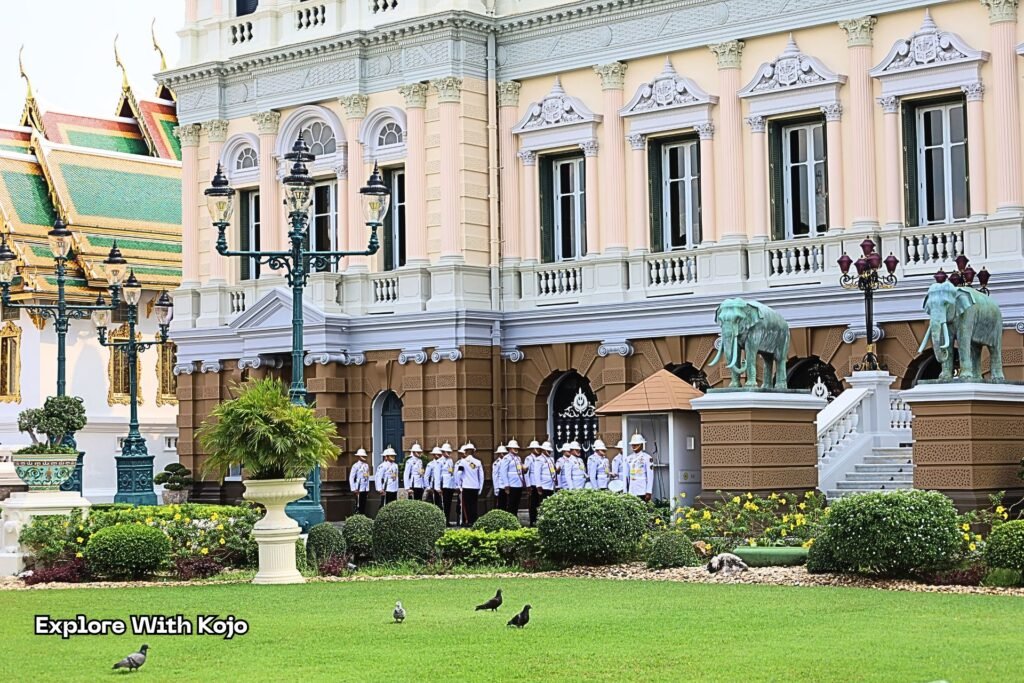
QUEEN SIRKIT MUSEUM OF TEXTILES
If you’re into expensive, fancy dresses, including some dating back to the days of old, you can also use the opportunity to hit up the Queen Sirikit Museum of Textiles. I’m not really into the history of fashion, but the exterior of the building is absolutely stunning, to the point of being worth the price of admission alone. And most of the items on display are exquisite enough to impress someone like me, who doesn’t even know what the word “textile” means.
CONCLUSION
I’ve already visited the Grand Palace of Thailand, but, if I find myself back in Bangkok in the future, I’ll go there again. One visit isn’t enough to take it all in, which is a common sentiment even amongst my Thai friends who grew up in Bangkok. I can’t think of any other place in the world that’s quite like this, a royal ceremonial site that used to also be the monarchy’s official residences and currently services as a country’s main tourist attraction. So if you’re in Thailand, do yourself a favor by spending a (likely hot) day at the Grand Palace. This place is too stunning and steeped in real history and religious significance for patrons to walk away unsatisfied.
Related posts:
 Best Things to Do in Bangkok 2025: My Personal Must-Visit Places and Experiences
 Thailand Visa Run Guide 2025: How It Works, Who It Affects, and New Rules
 Thailand Tourist Police Guide: Emergency Numbers, Offices, and How They Help
 Before Visiting Chatuchak Weekend Market in Bangkok, See This: My Real Photos and the Truth About the Market