Being a Successful Digital Nomad in Africa
Being a digital nomad in Africa can be a very rewarding experience, if your source of employment is foreign base. It’s easier to enjoy life in the Motherland when your source of income comes from abroad and particularly richer countries, like the United States and United Kingdom. You may also find remote work locally in Africa, but it isn’t going to pay as much. To minimize the possibility of having to endure financial instability, it’s imperative to lay your groundwork before coming over.
ESTABLISH YOUR PAYMENT PORTALS
In Africa, there are various avenues by which you can receive money from abroad. The most popular are remittance platforms like WorldRemit or Remitly. They aren’t ideal for remote work, simply because most employers may have their set system and refuse to pay through them. But if you find one who is willing, it’s a cool way to receive money straight onto your mobile device outfitted with an African SIM card. So you’ll not only receive your money instantly but also in the local currency.
Using ATMs is another option, if your pay is being deposited into a well-established bank at home. Remittance platforms have the advantage in convenience and provide better exchange rates. But banks are more ideal when you’re dealing with larger deposits.
There are also ways to access your bank account straight and convert withdrawals into local currencies. Some apps are also able to convert crypto into local currencies. To my knowledge, these methods aren’t extremely popular though may be preferred by some digital nomads.
If your employer insists on paying you through the bank but you prefer remittances, you can ask a loved one at home to receive your pay and extend it to you. This is especially beneficial if for whatever reason ATMs aren’t your preference. But either way, make sure you have a solid arrangement to be able to receive your pay before venturing over.
PAYPAL DILEMMA
If you don’t establish yourself properly beforehand, you may find it difficult, if not impossible, to set up a PayPal account or acquire an internationally-recognized credit/debit card in Ghana. One of the reasons digital nomadism isn’t as popular in Africa is due to the difficulty natives have in entering the global financial system.
So it’s better to verify your accounts and acquire your cards before coming over, all in the name of being able to receive your pay from the other side of the world expeditiously.
GET YOUR JOB BEFOREHAND
I recently met a lady from the east coast of the United States, who was living the life as a remote worker in Ghana. She brought her son and mom over and was celebrating how the latter’s health improved dramatically since moving to Africa. This lady was content more than the average person you come across out here, since she had a stable, Western-based income to depend on.
Well actually, I don’t know how stable the job may or may not be, as I haven’t seen her for a couple of months. You probably don’t need me to tell you that employment contracts are now more volatile than ever. Even Marvel Studios, the most-successful movie producer of the last 15 years, recently laid off a bunch of people.
Sometimes, this volatility can be beneficial to remote workers. For example, some of those people Marvel laid off have had their services retained as freelancers. So they’ve been more or less forced into digital nomadism. Or another way of looking at it is that employers often prefer remote workers because they’re less expensive to maintain. That isn’t true across the board but is common when it comes to this industry.
That’s what makes living in Africa with a foreign-based income ideal. With your income, you may have to struggle in your homeland. But if you’re based in Africa – with a steady, appreciable income of dollars (or Pounds, Euros, etc.) – you’ll be firmly entrenched in a middle-class lifestyle, one that’ll afford you the opportunity to live comfortably and travel.
The key is to have the job before you come over. There are so many advantages to getting the job at home before traveling. Applying from Africa, you won’t even get a chance with many of the better remote jobs, as they specify applicants be from a select country (like the U.S.).
Getting a job beforehand isn’t always necessary but is advisable if you want to avoid the stress of being in Africa without an income. Coming out here and trying to work a conventional 9 to 5 over an extended period isn’t really an option for the spirit of the nomad. Trying to conform to mainstream African working conditions is very uncomfortable, unless it’s a really good job.
As digital nomads, it’s normal to constantly search for better opportunities. So you may change jobs once coming over. But my advice when it comes to securing employment is similar to that with payment gateways. Have someone at home who, if need be, can apply for jobs for you. Some jobs are impossible to secure from Africa.
CONTROL YOUR EXPENDITURES
If you’re from a richer country, come to Africa and see how high your home currency flips, the euphoria – thinking you can afford any and everything – can get to your head. It’s inevitable that your cost of living will be higher than the average resident. So you don’t need to compound that reality with careless spending.
As a digital nomad in Africa, you can’t always live like a tourist. It’s good to have someone local you trust and can regularly consult with. You may have to pay for this friendship, but so long as the person isn’t conspiring with others to cheat you, it may be worth the price.
Acquiring short-term housing is financially preferable to living in hotels. Even if you move around a lot, there may be times you’re unable or unwilling to spend money. So at least you’ll always have a place to crash. And when choosing your domicile, make sure its environment is conducive to the type of work you’re employed in. Don’t just make the decision based solely on an eye test – try to know what type of people live in the area and the level of noise pollution (if any). Also note that it’s more affordable to rent outside of urban centers and away from areas that are popular amongst tourists.
REGISTER WITH YOUR EMBASSY
It’s a common practice for foreign embassies in Africa to require their citizens to register upon coming over. But it’s not like the embassy is going to chase you down if you don’t, and most visitors ignore this rule. That said, there usually isn’t any harm in taking the time out to register.
In a worst-case scenario, maybe you’re from a country that’s very unpopular amongst residents of the part of Africa you’re visiting. If the situation is that bad, then it may be best to avoid that country altogether, until things cool down.
You may never actually need to visit your homeland’s embassy, but it’s a good idea nonetheless. Embassy officials are a lot more immersed in the local system than you are. For example, they may offer their own citizens short-term job opportunities, i.e. local employment that pays in foreign currency, which is like a dream come true in Africa.
AFRICAN COUNTRIES THAT OFFER DIGITAL NOMAD VISAS
Unfortunately, there aren’t a lot of African countries with digital nomad visa schemes. But the continent as a whole appears to be more or less trending in that direction. An influx of outside funds (i.e. remittances, investments, loans, etc.) is a staple of many African economies, so governments understand the importance of hosting foreigners.
You don’t really need any type of special visa to visit or live in most African countries to begin with. The Motherland isn’t like the West, where foreigners get hounded by law enforcement. But if digital nomad visas were to become ubiquitous, that would more ideal. Residing in an African country with outdated papers may not land you in a detention center, but you will be denied certain benefits. So a digital nomad visa basically acts like a residency permit that extends beyond conventional visas, with longer intervals between renewals.
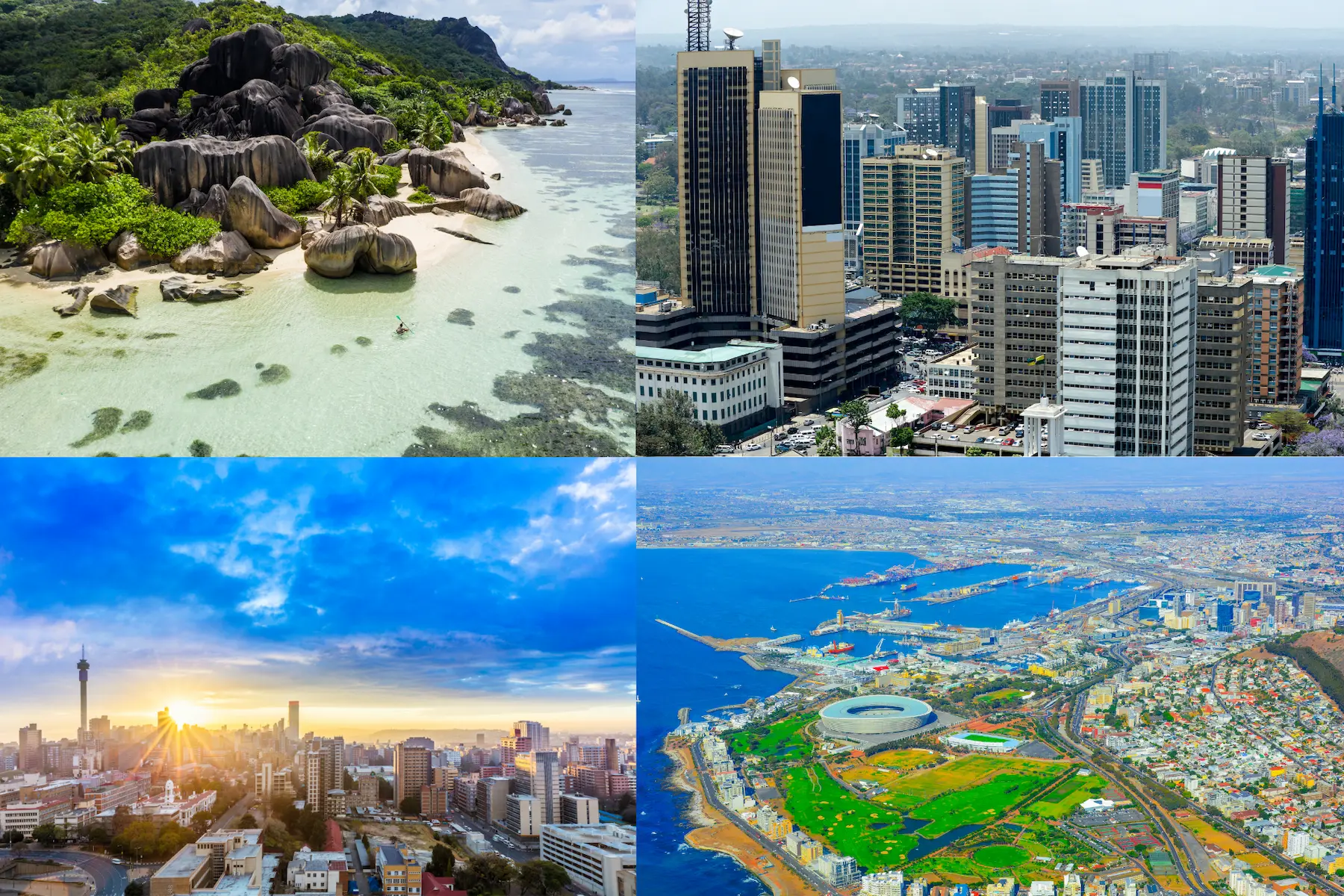
SOUTH AFRICA
South Africa is considered to be the only First World country in sub-Saharan Africa. Therefore, it is a destination that many outsiders, including digital nomads, prefer.
KENYA
Kenya, located in East Africa, is another popular entry on this list. And you don’t need to make as much money to qualify as a digital nomad as you would in South Africa.
SEYCHELLES
Seychelles is also in East Africa, though located out in the Indian Ocean. The requirements to acquire their workcation visa aren’t stringent at all. This is a cool choice for nature lovers, though the cost of living in Seychelles is high compared to some other African countries.
MAURITIUS
Mauritius, which lies off the coast of Madagascar, isn’t that far from Seychelles, so to speak. So if you’re intent on living on an island in the Indian Ocean, this is a more affordable option than its predecessor.
NAMIBIA
Namibia is doing what it can to attract digital nomads by providing a very applicant-friendly visa. It also borders South Africa, which is something to consider if you plan on visiting both countries.
CABO VERDE
It’s interesting that out of the six African countries that currently offer digital nomad visas, half of them are islands. That’s a fair amount of options if you want to engage in some true tropical chilling. But the downside is that all three on this list rank amongst the highest costs of living in the Motherland.
If you want to chill, you need to have the funds to support the lifestyle. That’s something to keep in mind when considering Cabo Verde, even though its digital nomad requirements are kinda moderate.
OTHER COUNTRIES
Honestly, when it comes to choosing where to settle in Africa as a digital nomad, the type of visa you’re applying for shouldn’t be much of a concern. If you’re forced to get a standard, shorter-stay visa, that usually means you’ll just have to renew it more frequently, besides acquiring other requisite paperwork for a longer stay. A digital nomad visa is definitely convenient but not absolutely necessary. The more important things to consider when making your decision is the safety of your desired destination and whether you’re making enough to live there like you want.
CONCLUSION
With the advent of AI, mass layoffs, rising fuel prices and other recent trends, being a digital nomad isn’t as stable as it was a couple of years ago. But it’s still an exciting lifestyle, and there are opportunities out there.
Meanwhile, Africa is relatively affordable and a nice place to live, if you know where to look. A safe bet is to go to a country with a designated digital nomad visa program. But if you prefer somewhere else, there are plenty of places in Africa that are willing to accommodate wage-earning foreigners.
If you really want to enjoy the digital nomad lifestyle in Africa, the most important thing is to make sure you’re receiving an adequate amount from abroad with as little drama as possible.