
Did Venezuela Really Take U.S. Land and Oil?
The United States and Venezuela have been engaged in a headline-worthy back and forth for over a couple of decades now. It’s been one of those types of situations where disturbing, politically-based claims and counterclaims have been levied by one party or the other. In the modern world, we’ve become accustomed to these kinds of rhetorical battles between nations. So when reported, news of the powerful United States beefing with the much weaker Venezuela tends to go in one ear and out the other.
But recently, this beef has taken a more serious turn. In September 2025, under President Donald Trump, the United States initiated military strikes in Latin America, officially in the name of combating drug traffickers. The U.S. has a major problem when it comes to its citizens patronizing dangerous, illegal drugs. Most of those substances come into the country from Latin America, more specifically Mexico and secondly from Colombia. So that then begs the question of why watercraft coming from Venezuela has thus far, relatively speaking, the primary targets of the U.S. in this campaign.
Operation Southern Spear
Since September, it has become increasingly apparent that Uncle Sam is using Operation Southern Spear, as this campaign is called, to possibly set the stage for the invasion of Venezuela. U.S. President Trump assured the public that war is not likely. Yet and still, the Donald appears to be hellbent on removing his Venezuelan counterpart, Nicolas Maduro, from power.
This is where it should be pointed out that President Maduro – as with his predecessor, Hugo Chavez (1954-2013) – is not a leader who’s intimidated by Uncle Sam. It can also be said that Venezuela is more or less part of the Eastern bloc, if you will, allying itself with countries like Russia and China.
President Trump’s Wild Claims
On 10 December 2025, the United States seized a Venezuelan oil tanker that was operating off the coast of the latter country. That’s when it started to become more apparent Operation Southern Spear isn’t all about combating “nacroterrorists”.
A recurrent theme in modern Western history is an imperial nation launching economically-motivated military actions against a weaker country but in doing so will publicly argue a more acceptable rationale. In this case, that rationale would be the war on drugs. And dubbing targets as “nacroterrorists” rather than conventional drug traffickers gives Operation Southern Spear a sense of higher urgency. Indeed, the use of that ambiguous designation is reminiscent of the days of old, aka the 20th century, when the U.S. rationalized its destructive meddling in Latin American affairs by rather targeting the likes of “communists”.
The Tongue of the Donald
Donald Trump is by far the most-outspoken US President of our time. He’s the president of the Information Age so to speak, boasting his own popular social-media platform and rarely holding back when it comes to making public statements
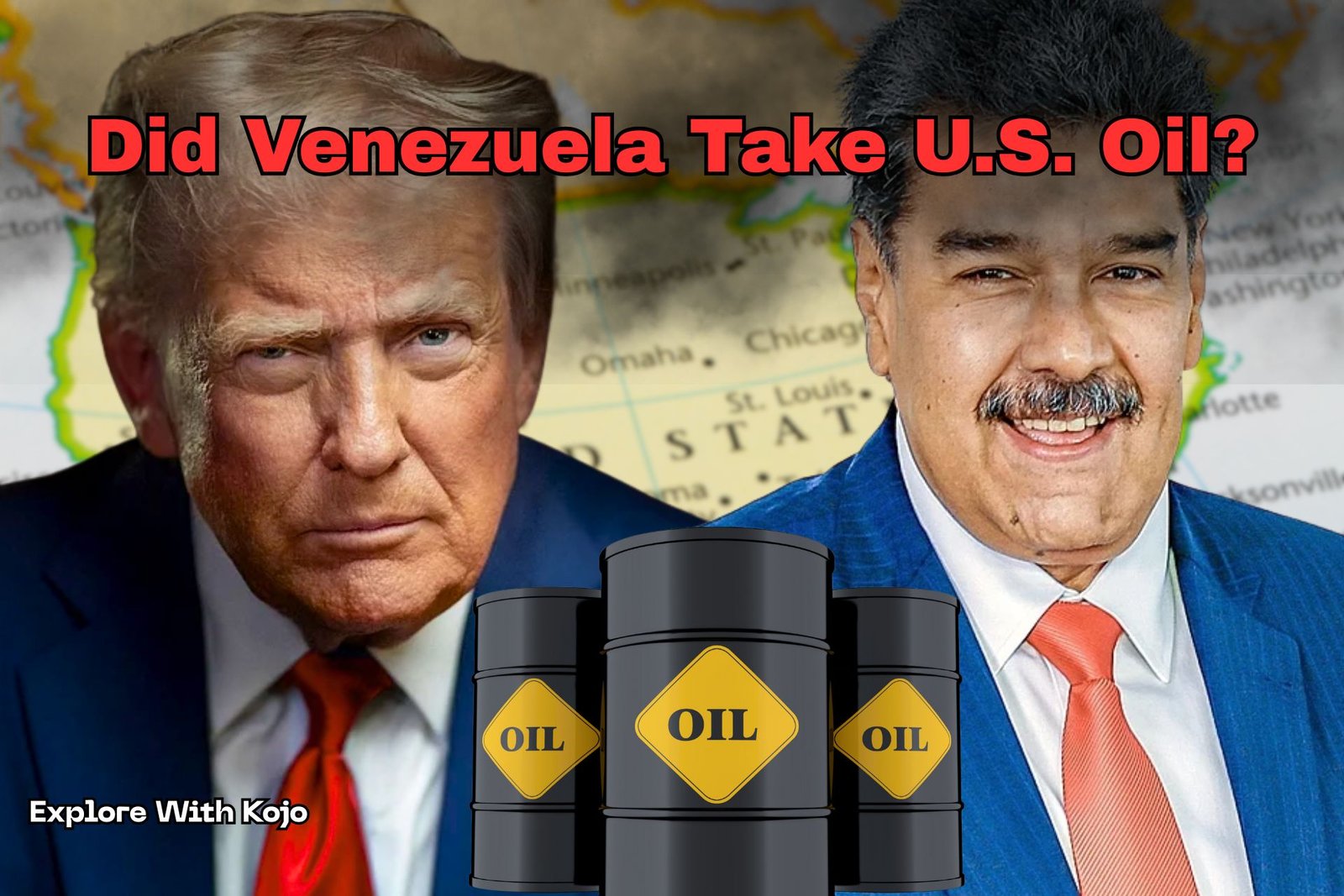
So on 17 December 2025, he made some accusations against Venezuela that really turned heads. That’s when Trump strongly implied that the current beef with Venezuela isn’t about drugs or even politics per se. Rather, the Donald accused the Venezuelans of “illegally” jacking the U.S.’s “energy rights” and “oil”. This all transpired, according to the US President, “not that long ago”. And now Trump and his cohorts “want it back”.
So basically, to encourage the Venezuelans along those line, President Trump has proceeded to surround the country with, in his own words, “the largest armada ever assembled in the history of South America”. And as implied, they will remain there and exert their will, such as seizing oil tankers (or worse), “until such time as (the Venezuelans) return to the United States all of the oil, land and other assets that they previously stole from us”.
What actually happened between the U.S. and Venezuela?
The United States has a recent history of exploiting South American countries, including Venezuela. It was easier to take advantage of the Venezuelans in times past, when they were under the rule of dictators like Juan Vincente Gomez (1857-1935) and Marcos Perez Jimenez (1914-2001), who ruthlessly oppressed their people with U.S. backing.
But during the last decade of the 20th century, Venezuela experienced what is known as the Bolivarian Revolution, spearheaded by the aforementioned Hugo Chavez. According to the U.S. Army, this movement “was characterized by a hostile and confrontational posture toward the United States”. And heading into the 21st century, it helped redefine the political relationship between Venezuela and the United States.
But even prior to the 1990s, the Venezuelans were trending towards minimizing foreign exploitation of their resources. Nature would have it that Venezuela is filthy rich in petroleum. When this wealth was first discovered, British and American countries seized control of virtually all of it. This was circa the early 20th century, when such colonial nations were running roughshod all over the place.
As the century progressed, weaker nations like Venezuela caught on to the game and began striving for more autonomy. The Venezuelan government for instance began demanding a higher share of oil revenues as early as the 1940s. And in 1976, it proceeded to nationalize the industry. And it was the profit line of major American corporations we all know – Exxon, Mobil and Gulf Oil – that paid the price.
The Intricacies of Neocolonialism
These types of situations, where billions of dollars are at stake and millions of lives are affected, aren’t as simple as ‘you took from me, and now I’m taking it back’. These systems are based just as much on contracts as they are the military might of the metropole. For example, the aforementioned nationalization wasn’t the result of a sudden uprising against American powers. Rather, as The New York Times puts it, that “process was a negotiated transition after decades of incremental policy shifts”.
Later down the line, under the presidency of Hugo Chavez, Venezuela did go through what is known as the Bolivarian Revolution. Simon Bolivar (1783-1830), whom the movement is named after, was a legendary Venezuelan revolutionary who was instrumental in freeing a number of Latin American countries from Spanish rule. The Bolivarian Revolution is not violent in and of itself. But even into the here and now the Venezuelan government, through this initiative, feels the need to promote – even at risk of pissing off the West – nationalism and economic independence throughout the region.
Or another way of looking at it all, within the context of this discussion, is like this. Donald Trump is not only the President of the United States but also the quintessential American business magnate. It can also be gleaned that he’s very much a nationalist. So in his eyes, entities like those aforementioned American corporations perhaps have every right to plunder Venezuela’s oil.
Such a Touchy Topic
It’s a touchy topic that would take looking at all of the contracts which have defined this relationship throughout the decades to comprehensively understand. But more simply interpreted, what it boils down is right versus wrong, oppressor versus oppressed. Even if you do sign a bad contract, under some type of duress or in a state of weakness, does that give the other party the right to take advantage of you into perpetuity?
So it isn’t uncommon for observers to view the United States as a bully in the way it has treated Venezuela. Going back to the early-19th century, the U.S. has idealized exerting economic dominance over the entire Western Hemisphere. That ambition has more or less taken a backseat in recent years – that is until Trump became president and began reminding other countries what the United States is really about.
Legal Context of the Battle for Venezuela’s Oil
Under international law, nationalism is very much legal – with conditions. You would think that the people who write these laws would recognize a poor country’s right to claim its resources from a foreign oppressor. But again, things aren’t that simple.
In the eyes of international law, there’s a difference between lawful and unlawful expropriation. In summation, nationalists do have the right to boot foreign corporations from their borders, towards the good of their own people. But if said corporations are powerful enough, they can seek restitution from the country that’s exerting its independence from them. And that has been a common theme in the United States’ business relationship with Venezuela in recent times.
American Big Oil’s Presence in Venezuela
‘The oppressor and the oppressed never see things alike’. During the 20th century, the United States managed to establish a strong presence in Venezuela. And that included American companies edifying certain enclaves within the country.
It’s safe to say those communities, backed by Big Oil’s massive bankroll and the U.S. government’s blessings, were much better off than common parts of Venezuela. Or a simpler way of looking at it is that Big Oil, in their own way, did contribute to the development of the country. And as alluded to earlier, there was a time when they were firmly supported by the Venezuelan government, even if it were run by puppet administrations. And within the context of (neo)colonialism, it was those companies who taught and equipped Venezuela to extract oil to begin with.
But even if you are able to perceive the benefits of being under someone else’s thumb, you would not want to stay there forever. At the end of the day, it’s only right that Venezuelans would want to be the primary beneficiary of their own oil.
But despite nationalization and all, American oil companies have continued to operate therein. Truth be told, it isn’t particularly wise for any country to terminate all foreign-based private investment within its borders. As time has progressed, the Venezuelan government has been exerting more control over Big Oil. However, the increased revenues which came from that stance did not have a long-term positive effect on the people.
Corruption and Mismanagement
Meanwhile corruption and mismanagement, as reportedly is rampant within the Venezuelan government agency tasked with taking over the oil sector, gives people like President Trump even more of a rationale to act against Venezuela. For instance, during his first presidency the U.S. imposed sanctions on Venezuela, officially due to the country being embroiled in a humanitarian crisis. Those sanctions largely targeted the oil sector, furthermore seeking to pressure President Maduro into resigning. And to note, that latter ambition also remains very much in effect. As of this writing, Trump has officially placed a $50 million reward on the capture of Maduro, whom the Donald’s government claims is akin to a high-level, drug-dealing gangbanger.
Conclusion
Did Venezuela seize oil assets that previously belonged to U.S. companies operating within its borders? Yes, it did. Those kinds of things sometimes happen within the context of neocolonialism. You have a foreign company on your land, making more money from your resources than you are. And nations who are subject to this kind of abuse sometimes reach the breaking point and rise up against their plunderers.
But did Venezuela actually steal those assets from the United States, as President Trump has asserted? The answer, all things considered, would have to be a firm no. International law, which was most likely written by the selfsame plunderers, needs to be modified to become more compassionate towards the oppressed. No doubt that corporations like Exxon have already made enough dough at the expense of the Venezuelan economy. Building a hospital or developing a town here and there doesn’t amount much if the masses of people remain poor.
Obviously, the Venezuelan government has its own issues when it comes to managing its oil wealth and using the funds wisely. But at the end of the day, that’s what sovereignty is all about. Better to let the people rise and fall by their own hand than to let a foreign nation exert economic dominance over their resources.

