
How African Black Soap Is Made in Ghana: A Local Tour Experience in Photos
When I visited Tamale, one of Ghana’s most culturally rich cities, I wasn’t expecting to end up inside a black soap factory. But that’s exactly what happened.
Locals told me about Mr. Lawrence Owusu, a production manager at Suglo Enterprise, known across Northern Ghana for producing authentic African black soap using time-honored techniques. He kindly invited me to his production site – and what followed was one of the most educational and inspiring tours I’ve ever taken in Ghana.
If you’re ever in Tamale, this is one of those real local experiences you shouldn’t miss. You’ll see how something so simple – soap – carries generations of wisdom and creativity.
1. Gathering the Ingredients
It all starts with ingredients drawn from the land – palm kernel oil, shea butter, neem oil, and potash made by burning cocoa pods into ash. Some producers also add coconut oil, plantain leaves, or herbs depending on the purpose of the soap and what clients request.

Fresh palm kernel oil stored in reused jerry cans. This golden oil is apparently the heart of every authentic African black soap batch.

This bucket holds the potash solution made by burning cocoa pods. It’s mixed with natural oils to begin the soap-making process.

The secret ingredient – finely burned cocoa pod ash. It gives African black soap its cleansing power and distinct earthy tone.
Standing there in Tamale, watching the raw materials laid out under the sun, I realized how connected this process is to the environment. Nothing is wasted here. Every bit serves a purpose.
2. Mixing the Potash Solution
The burned cocoa pod ash is mixed with water to form liquid potash, which acts as the base for soap making. The process looks simple, but as Lawrence explained, the exact ratio of water to ash determines how strong and smooth the final soap becomes.
This step reminded me of how traditional knowledge often rivals modern chemistry – learned not in labs, but passed down through generations.

The cocoa pod ash is mixed with water to form liquid potash, which is the natural alkaline base that transforms oil into soap. It’s Africa’s version of a chemistry lab, done by hand and guided by experience.

What’s left behind after filtering the potash solution. Even the waste is proof that nothing goes unused in traditional African soap-making.
3. Combining the Oils and Potash
Next, the palm kernel oil, shea butter, and neem oil are mixed with the liquid potash and slowly heated over a wood fire. The thick mixture bubbles and changes color as it cooks, filling the air with a strong, earthy scent.

In his small workshop, Lawrence uses simple, locally made tools to stir and later mold the soap. Everything here is done by hand.
“The longer we cook it, the darker it becomes,” Lawrence told me, stirring the pot with steady hands. “Some clients want a deep black color, others prefer it lighter.”

The mixture thickens over fire as the oils react with the potash. The longer it stays on the fire, the darker the soap becomes, which is a detail only experience can teach.
This is where craftsmanship meets intuition. As you can clearly see there are no timers nor sophisticated machines. All you see is experience and observation.
4. Cooking and Stirring
The mixture continues to cook for hours, thickening into a rich, sticky paste. The intensity of the fire determines how dark the soap will turn out. Watching it bubble, I understood why African black soap is both an art and a science – guided entirely by feel and tradition.

The thick mixture begins to bubble and shift in color as it cooks. The fire crackles beneath the pot, releasing that unmistakable earthy aroma of authentic African black soap in the making.

The soap cooks slowly over wood fire. In the process, the heat darkens the texture, while the smoke gives it character.

Rows of steaming pots fill the air with smoke as multiple batches are made side by side. Watching it all unfold, I understood why black soap is as much an art as it is a science.
5. Scooping the Soap from the Fire
Once the texture is perfect, the hot soap is carefully scooped out into metal pans. It’s a tough, sweaty job, but the pride in the workers’ faces says it all. At this point, the soap looks nothing like what you see in stores. It’s rough, uneven, and alive with color.

After hours of slow cooking, the soap is finally ready.

Each scoop of hot black soap is heavy and sticky, but this is the most satisfying part of the process. The hard work and patience are visible in every motion.

The soap is transferred into metal pans to cool. This is where the transformation begins – from a bubbling mass on fire to the natural skincare treasure the world loves today.
6. Pouring and Drying
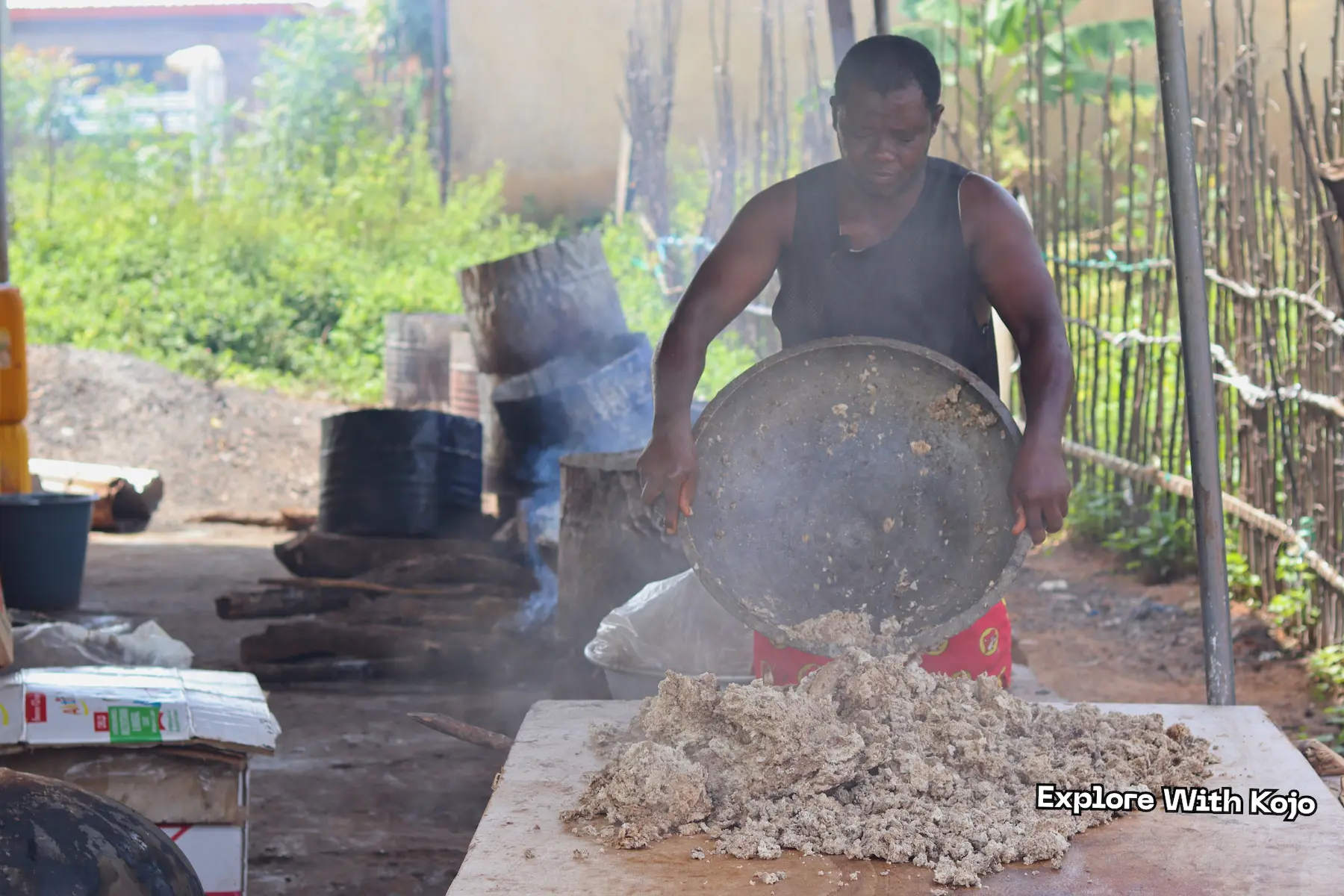
The soap is then poured out to cool and harden. After a few hours, it’s broken up, crumbled, and left to dry under the open sky. The Northern sun in Tamale does its part here – helping turn raw material into one of Africa’s most beloved natural skincare products.

After hours over the fire, the soap is finally poured out to cool. The thick mixture slides from the pan like lava – signaling the end of heat and the start of transformation.

As it cools, the soap is crumbled and left under the Northern Ghana sun to dry naturally.
7. Molding the Soap and the Finished Product
Once dry, the soap is molded using simple tools into round or block shapes, ready for packaging and sale. Each mold carries its own rustic imperfections, which is proof that this is handmade, not machine-pressed.
Finally, the soap is cooled and packaged. Some are wrapped in reused cement paper, while others are sealed in clear plastic for export. No matter the packaging, each bar holds the same story – a story of resourcefulness and African pride.

The cooled soap is pressed into shape using a simple metal mold.

This is what the final product looks like before it’s wrapped and sent off to markets across Ghana and beyond.
As I held the finished soap in my hands, I realized this was more than skincare. This is actually a living tradition that connects people, nature, and culture.
A Cultural Experience for Visitors
If you’re visiting Tamale, you can book community tours that include black soap workshops like this one. These experiences offer a real taste of Northern Ghana – not just sightseeing, but learning from artisans who still make things the traditional way.
I can promise you that at the end of the day, you’ll leave with more than just photos. You’ll take home knowledge, appreciation, and maybe even a bar of soap made right before your eyes.


