
Tamale Ghana Photo Tour: Markets, Mosques, and Daily Life
If you ever travel to northern Ghana, you’ll find yourself in a city that moves to its own rhythm. Tamale is the capital of the Northern Region of Ghana. It is a city powered by motorbikes, markets, and a deep sense of community. Life here feels both simple and full of motion. If you visit Ghana and fail to travel to Tamale, then you have done yourself a huge disservice.
A City of Colorful Markets
Tamale’s Central Market is the heartbeat of the city. From early morning, traders set up stalls selling everything from shea butter and dried fish to colorful fabrics and handmade baskets. The air fills with voices bargaining, motorbike engines humming, and the smell of roasted corn drifting from nearby stands.

A typical day on the streets of Tamale’s bustling main market.

The heart of Tamale’s economy beats strongest in its markets.
Markets here are not just for shopping. The markets also serve as meeting points where people catch up, share stories, and connect over trade. A walk through the market tells you everything you need to know about the city’s energy.
The Land of Motorbikes
If there’s one thing you notice right away in Tamale, it’s the sound of motorbikes. They dominate the streets, serving as taxis, delivery vehicles, and family transport. Nearly every household owns one, and it is common to see men, women, and even children riding with confidence.

The Tamale Central Market bursts with color and sound on a busy day.

Tamale’s streets are filled with the sound of motorbikes and Yellow Yellows.
Motorbikes have replaced bicycles as the main form of mobility. They are affordable, fast, and very practical for daily life in the city. Even those who own cars often have a motorbike too. For many, it represents independence and pride.
Meet the “Motorking” and the “Yellow Yellow”
Tamale’s streets are also filled with three-wheel vehicles. The first is the Motorking, a tricycle used mostly to carry goods and sometimes passengers. It has a large bucket at the back that can hold firewood, food, or even people heading home from the market.

A woman transports her goods in a Motorking tricycle through Tamale.

Village women head home after selling goods in Tamale’s market.

Women share a ride home in a Motorking after shopping at the market.
Then there’s the Yellow Yellow, which is Tamale’s version of a local taxi. These small, open tricycles can take you almost anywhere in town at an affordable price. They are cheerful and always in motion.

A busy Yellow Yellow station where Tamale’s tricycles wait for passengers.
Yellow Yellows have become part of Tamale’s identity. For visitors, riding one is an experience worth having. For locals, they are essential for getting to work, school, or the market.
A City Built on Hustle and Heart
Tamale’s people are known for their hard work and hospitality. Traders work long hours, often under the sun, yet they greet you with smiles and warmth. Women dominate the local markets, selling food, fabrics, and household items with pride.

Traders hustle from stall to stall to make the most of market day.

Women dominate Tamale’s markets, handling much of the day’s trade.

The center of the market is where the busiest deals happen.

A bread seller calls out to customers during a busy morning at Tamale market.
For many families, trade is more than a job. Many see it as a way of life passed from one generation to the next. And when you walk through the markets, it doesn’t take long for you to realize how they reflect both the struggle and the strength of the people.
Landmarks that Tell Stories
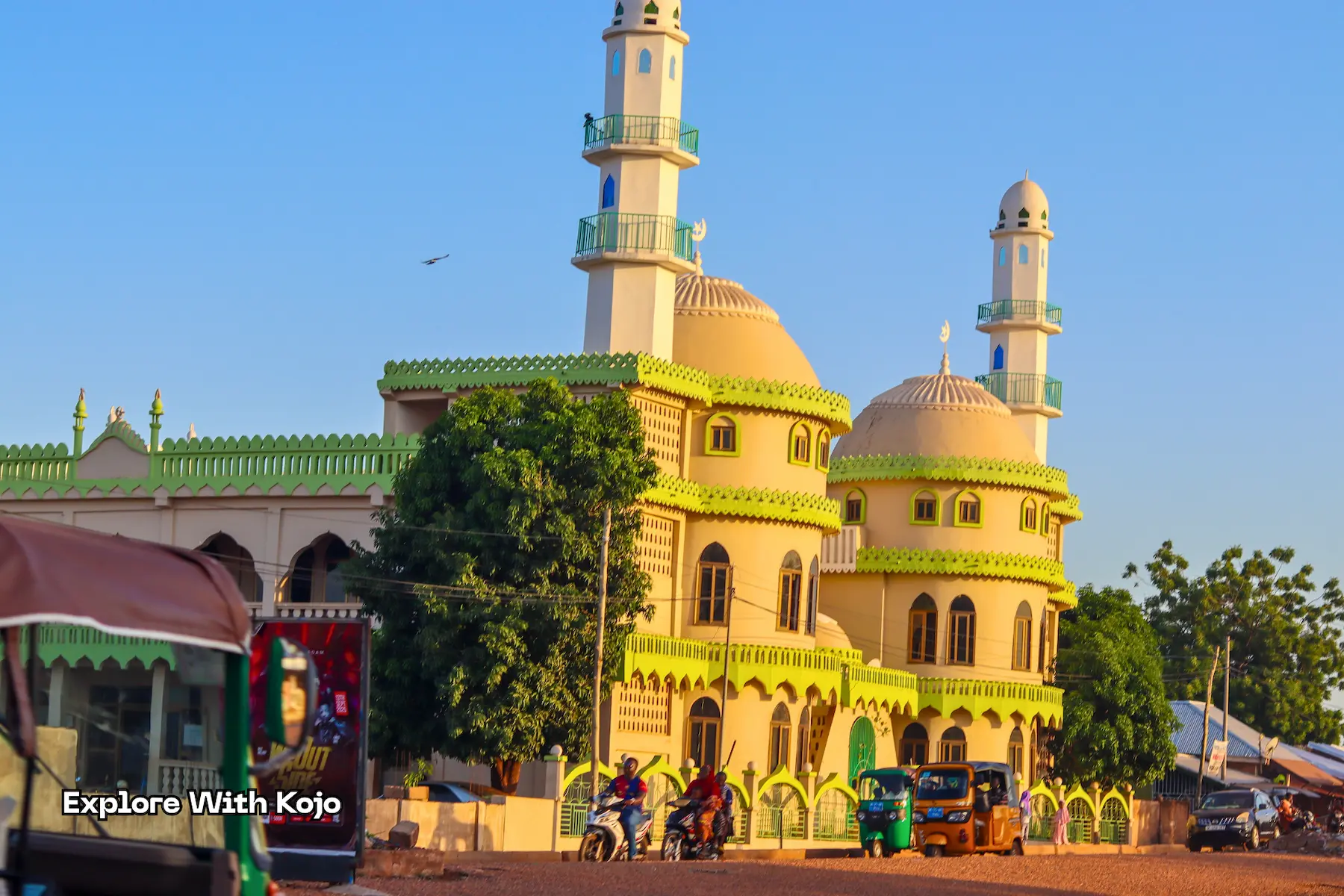
Beyond the bikes and markets, Tamale has places that carry history and pride. The Tamale Central Mosque stands tall with its green domes.

The iconic Tamale Central Mosque stands tall against the city skyline.
Nearby, the World War II Veterans Square honors Ghanaian soldiers who fought bravely overseas.

The World War II Veterans Square in Tamale honors the city’s fallen heroes.
And not far from the city center stands the State Office Complex, one of the first government buildings constructed by Dr. Kwame Nkrumah after Ghana’s independence.

This historic office complex was built during Kwame Nkrumah’s leadership.
These landmarks remind residents of Tamale’s contributions to Ghana’s history and its steady growth since independence.
Everyday Life in Motion
From the rooftops of Tamale, you can see a city alive with rhythm. Rusty metal sheets shimmer in the sunlight, reflecting the heat of the north.

The rooftops of Tamale stretch into the horizon in soft evening light.

A wide view of Tamale’s old neighborhoods covered in rusty tin roofs.
Down below, people go about their day. You’ll find riders heading to work, women balancing baskets on their heads, and traders setting up under colorful umbrellas.
A typical day on the streets of Tamale’s bustling main market.

Market Street in Tamale stays crowded from morning until evening.
This everyday motion is what makes Tamale special. It is a place where tradition meets energy, where old and new coexist.
Tamale Today
Modern developments like the Tamale Teaching Hospital and the new overpass show how the city is changing while staying true to its roots.

The Tamale Teaching Hospital serves as the main health facility in northern Ghana.

Market day in Tamale is always full of color, sound, and movement.
Even with growing modernization, Tamale keeps its charm. It remains one of Ghana’s most authentic cities.
Why Tamale Deserves Your Visit
Tamale is not about luxury resorts or nightlife. The city’s beauty lies in the people and the everyday scenes that tell you what life in northern Ghana is really like.
The Tamale Central Market bursts with color and sound on a busy day.
If you ever visit, don’t rush. Spend time in the markets, ride a Yellow Yellow, and watch the sunset over the rooftops. You won’t leave with just photos but also with a very great perspective. Ghana is blessed with many amazing cities that you must visit, and Tamale is definitely one of them!
Related posts:


EWK is the voice of Explore With Kojo, a global travel platform that goes beyond postcards and tourist hotspots. We explore the real stories, raw truths, and human moments that mainstream travel media often misses. Whether we’re answering your questions, sharing photo essays, or documenting life-changing journeys, our mission is simple: to show the world with heart, honesty, and curiosity.