
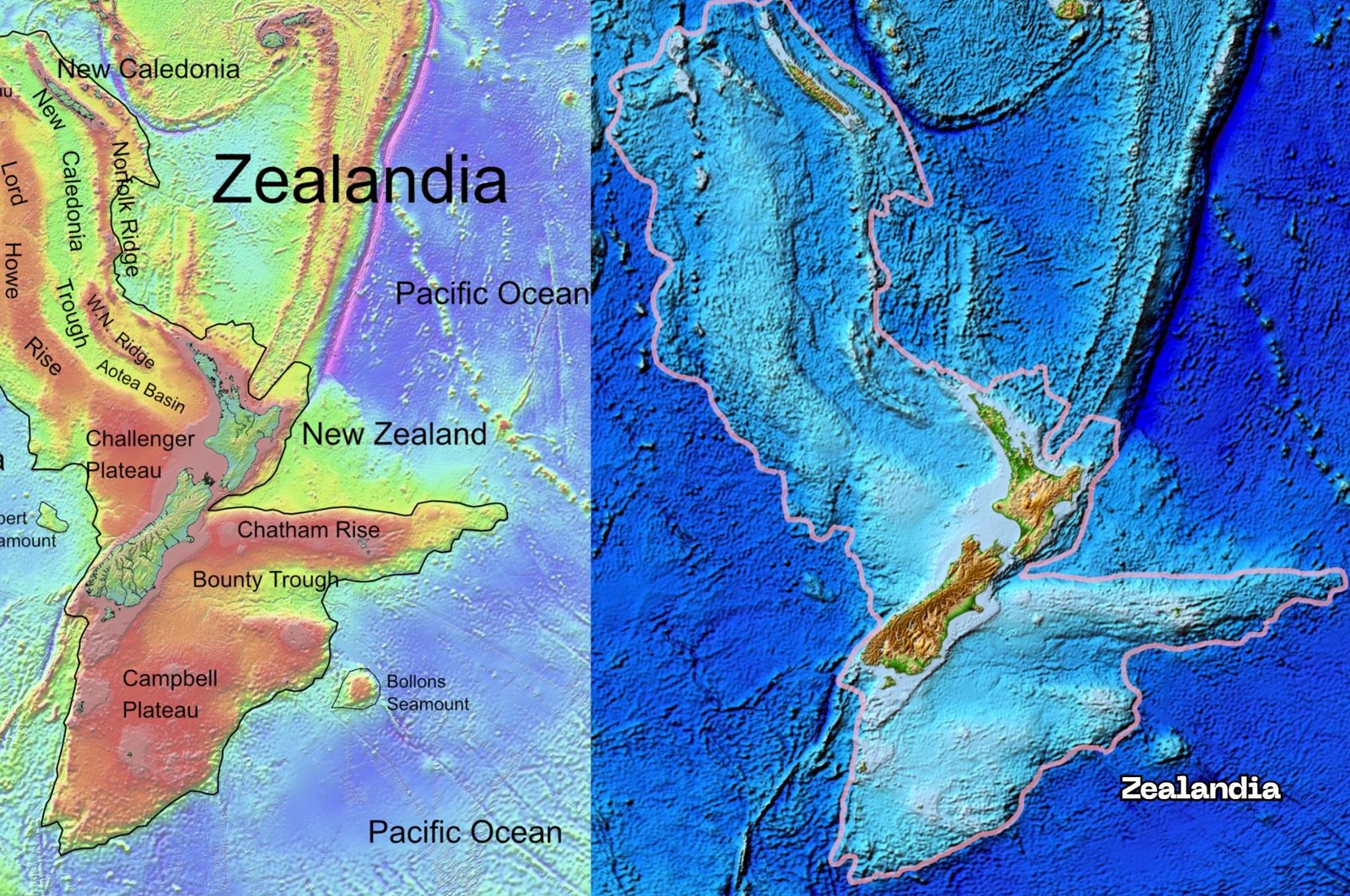
Zealandia, The Earth’s 8th Continent
There was a time – millions of years ago, before the existence of human beings – when the crust of the Earth consisted primarily of a single landmass. That supercontinent, as it’s sometimes termed, is known in scientific circles as Gondwana.
Gondwana itself consisted of a collection of extremely-large landmasses which collided together. But eventually it came apart, forming most of the world’s Southern Hemisphere as we know it today. It was the fragmentation of Gondwana for instance that led to the formation of Africa, South America, Antarctica and Oceania, as well as large swaths of Asia. Indeed, if you were to look at a map, you’d see that the shapes of western Africa and eastern South America sorta fit together, like a jigsaw puzzle.
On the surface, Oceania doesn’t appear to mesh together as easily. In other words, the shape of New Zealand doesn’t fit like a jigsaw puzzle with Australia. But apparently, there’s a very logical explanation for this. The vast majority of New Zealand, if you will, is actually underwater.
THE DISCOVERY OF ZEALANDIA
In 2017, scientists confirmed the existence of Zealandia, a mass of land so big that some have come to refer to it as the world’s “eighth continent”. Zealandia lies just northeast of the Australian continent and again is extremely large in size.
So why is it that most of us have never heard of Zealandia? And why, if it’s so huge, that its existence has only been verified as recently as 2017? That’s because, to reiterate, the overwhelming majority of Zealandia is submerged and has apparently been for a very, very long time. And only recent technological advancements has made its detection, in entirety, possible.
HOW BIG IS ZEALANDIA?
There are conflicting reports as to how big Zealandia actually is. According to some sources, it’s about 2 millions square miles or 5 million square kilometers. That would make it about two-thirds the size of Australia. But other sources contend that Zealandia is actually bigger than its Western neighbor, as it comprises roughly 6% of the total land surface of the Earth (as compared to Australia’s 5%).
In any event, Zealandia is too large to be unanimously classified as a microcontinent. As far as microcontinents go, Madagascar, off the coast of East Africa, is historically considered to be the world’s largest. But Zealandia is a whopping six times bigger than that landmass.
That is why some observers would rather refer to Zealandia as “the eighth continent” rather than a microcontinent. It is closer in size to Australia than it is to Madagascar. But unlike conventional continents, whether standard or micro, most of Zealandia is very much uninhabitable.
THE HABITABLE PARTS OF ZEALANDIA
Relatively speaking, only a very small percentage of Zealandia lies above sea level, thus making those sections habitable. At the top of the list is New Zealand, a well-known country with a population of over 5 million people. In fact Zealandia, as you probably already deduced, was named after New Zealand.
Second on the list is the much lesser-known island nation of New Caledonia, a French territory that only houses about 250,000 residents. Besides that, Zealandia comprises a handful of notable coral reefs which are controlled by Australia. But in summation, 94% of the landmass is submerged.
It’s safe to say that if Zealandia had not been engulfed by the Pacific Ocean, it would be just as populated as the other continents of the world. But since it is believed to have gone under millions of years ago, chances are people never lived there outside of the aforementioned islands. So Zealandia wouldn’t be like a lost city of Atlantis, if you will.
PLENTY OF VOLCANIC ACTIVITY
One of the more interesting features of Zealandia is its high level of volcanic activity. This is not only in a modern context but also very much in relation to the past. The latter fact is important from a scientific perspective, as volcanoes tend to preserve information so to speak, that can be studied by later generations.
CAN WE VISIT ZEALANDIA? AND WHAT’S ITS FUTURE?
Zealandia isn’t terribly submerged, laying 1-2 kilometers or about one mile under sea level. But of course, that’s still deep enough to make it totally uninhabitable by us human beings. So outside of New Zealand and New Caledonia, it doesn’t appear as if anyone will be settling on the continent anytime soon.
The greater significance of Zealandia, as a whole, is its academic significance. For instance, scientists are able to study the area to get a better understanding of the environmental and geological history of the South Pacific. It is also considered to be important in piecing together the geological history of the Earth as a whole. Indeed, a major component of the Gondwana jigsaw puzzle has now been discovered.
Also interesting to note is that Zealandia features a significant amount of natural resources, i.e. minerals, gas, oil, etc. Some, such as the Maui gas field, are already in use, with offshore drilling having commenced in the region during the mid-20th century. There is also a significant amount of mining activity, spearheaded by New Zealand, being conducted in Zealandia. But by the looks of things most of the continents natural resources, besides land even, remain untapped, which is understandable considering it’s underwater and all.
And regarding whether tourists can visit Zealandia, the answer is no. And the primary reason this is the case is because like I said earlier, the continent is mostly underneath water. Actually it is reported that over 94 percent of the continent is submerged. This basically means that there is no place you can go and say that you are standing on the continent.
CONCLUSION
It’s fascinating to know that there are actually eight continents, not seven as we are regularly taught in school, and that the eighth is almost completely underwater. It’s one of those types of facts that can make us realize just how small we, as individuals, are in the grand scheme of things, as well as how old and majestic the world actually is. There are so many mysteries out there that we are totally aloof to, and there are more enigmas lying underwater than we can possibly imagine.


