Mexico Flag: History, Facts, and the Meaning Behind Its Colors
Few national flags in the world are as deeply rooted in history as Mexico’s. Officially adopted in 1821, the Mexico flag combines the struggle for independence, the influence of Catholicism, and ancient Aztec mythology into one powerful emblem. Today, this flag stands as a unifying symbol for Mexicans at home and abroad, linking the past with the present.
A Brief History of the Mexico Flag
The story of the Mexican flag began proper somewhere in 1821. The year in question is the same year Mexico declared independence from Spain after more than three centuries of colonial rule. The first official flag carried the familiar green, white, and red tricolor. This design was inspired partly by the French Revolution’s ideals such equality and fraternity. However, it later adapted with meanings unique to Mexico’s struggle for freedom.
While the stripes remained consistent, the central emblem of the eagle, serpent, and cactus has seen multiple redesigns over the decades. Different governments, both conservative and liberal, modified the details of the eagle. Sometimes the changes saw the eagle facing left and sometimes it would face right. Even sometimes it would appear with wings folded or spread. Each version reflected the politics of the moment but always kept the core symbolism alive.
The design we know today was officially adopted on September 16, 1968, Mexico’s Independence Day, and just weeks before the country hosted the Summer Olympics. It was meant to present a clear, unified image of Mexico to the world stage. Since then, the flag has remained unchanged, standing as a timeless symbol of national identity, unity, and resilience.
What Do the Colors Mean?
Like many national flags, the three colors of the Mexican flag are more than decorations. They tell a very, very deep story. Let’s look at the story of the Mexican flag below:
- Green: Originally tied to independence from Spain, today it represents hope, prosperity, and the promise of a better future.
- White: Once a symbol of the Catholic faith, it has since evolved to represent unity, peace, and purity of ideals.
- Red: The world is to ensure that people never forget the blood shed by national heroes, from independence fighters like Miguel Hidalgo to those who defended Mexico’s sovereignty in later conflicts.
Interestingly, the meanings of these colors have shifted over time. In the 19th century, they carried more explicitly religious connotations. As Mexico modernized and became more secular, the interpretation shifted toward ideals of liberty and national pride. Today, the colors capture both Mexico’s independence story and its ongoing journey as a nation.
The Coat of Arms
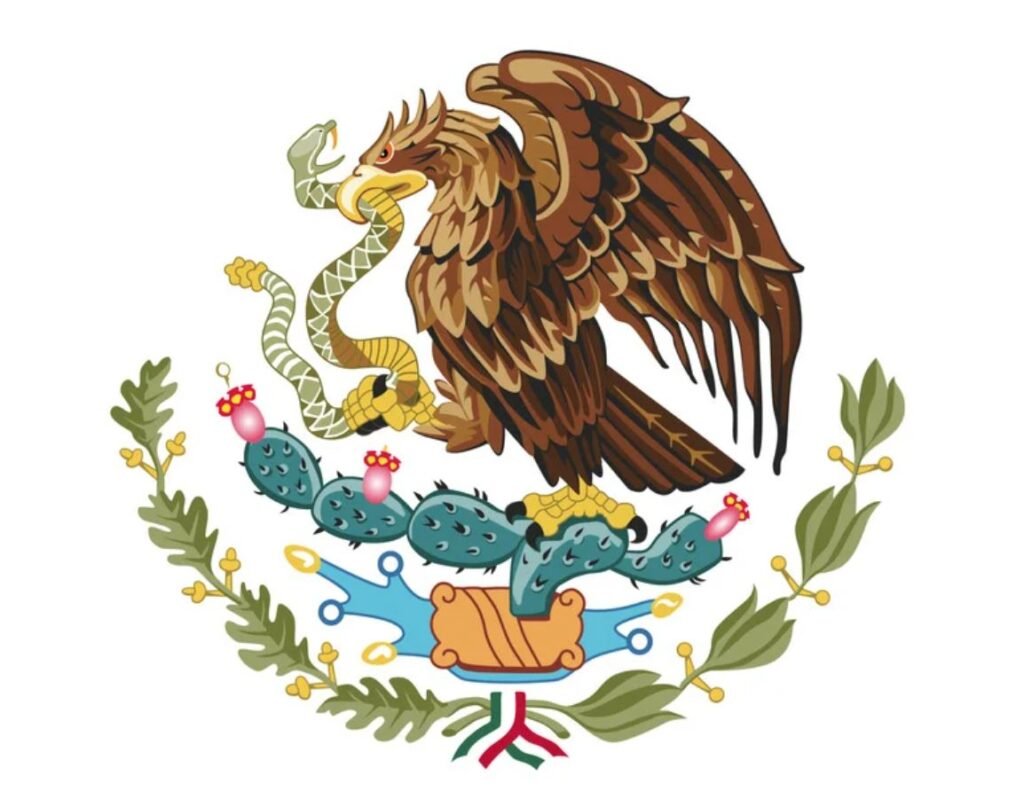
Eagle, Snake, and Cactus
Perhaps the most striking feature of the Mexican flag is its coat of arms, displayed in the center of the white stripe. Few national flags carry such a vivid story in their design.
It shows an eagle devouring a snake while perched on a prickly pear cactus that grows out of a rock in the middle of a lake. This image comes from a foundational Aztec legend. According to the myth, the gods instructed the Aztec people to settle wherever they saw this exact vision. After a long journey, they witnessed it on a small island in Lake Texcoco, where they founded Tenochtitlán, the heart of the Aztec Empire. That site later became Mexico City, the nation’s capital.
Quick Facts About the Mexico Flag
Before we wrap up, here are some quick and interesting facts about the Mexico flag that every visitor and history enthusiast should know.
Flag Day (Día de la Bandera)
Celebrated every year on February 24th, this holiday honors the national flag with ceremonies in schools, plazas, and government buildings. For travelers in Mexico, it’s a chance to witness patriotic parades and ceremonies.
The World’s Largest Mexican Flag
If you’re visiting Mexico City, one of the most unforgettable sights is the massive Mexican flag that dominates the Plaza de la Constitución (Zócalo) – the heart of the capital. This isn’t just any ordinary flag. Measuring an incredible 50 meters long by 28 meters wide and weighing over 200 kilograms, it is one of the largest national flags in the world.
Every morning and evening, the flag is raised and lowered in a highly choreographed military ceremony conducted by the Mexican army. Soldiers march in perfect unison as the flag is carefully unfurled or folded. As this is carried out, onlookers often pause to watch and sometimes even join in saluting. The ceremony is always solemn and very moving.
For travelers, it’s not only a chance to witness Mexican national pride up close but also to stand in the middle of the Zócalo, one of the largest public squares in the world, surrounded by iconic landmarks such as the National Palace and the Metropolitan Cathedral. It is a very lovely display to experience.
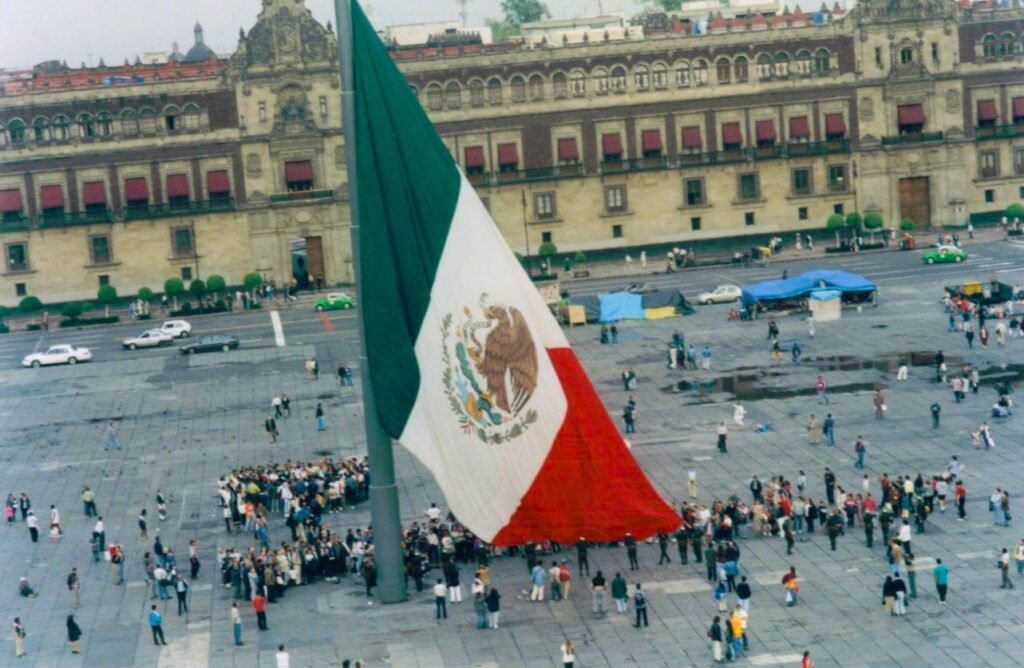
The Mexican army raising the world’s largest flag at Zócalo, Mexico City’s historic main square.
Traveler Tip: Arrive just before sunset to catch the lowering ceremony. It’s a perfect moment for photography, with the massive flag waving against the evening sky and the historic square glowing in golden light.
Military Flag Ceremonies
In many cities, especially in Mexico City, you can watch the changing of the guard and the ceremonial raising and lowering of the flag, a moving display of respect and national pride.
Respect Rules
In Mexico, the flag is treated with the utmost reverence. Damaging, desecrating, or using it improperly is punishable by law. Even ordinary citizens stand still and salute when the flag is raised during public events.
Similarities With Other Flags
At first glance, the Mexico flag is often compared to the Italian flag. This is because both feature vertical green, white, and red stripes. However, the key difference lies in the Mexican coat of arms (the iconic eagle, snake, and cactus emblem) that sets it apart and tells a uniquely Mexican story.
This similarity sometimes causes confusion, especially for travelers seeing the flags side by side at international events. But while the Italian tricolor was inspired by the French Revolution and represents liberty and fraternity, the Mexican flag draws from both its independence movement and its ancient Aztec heritage.
Mexico’s flag also shares thematic traits with other Latin American flags that use tricolors and national emblems. For example, Ecuador and Colombia, feature unique coats of arms to express cultural identity.
What makes the Mexican flag stand out is that it carries a mythological legend at its center. And thy mythological legend is focused on the founding of Tenochtitlán, the capital of the Aztec Empire and today’s Mexico City.