10 Famous Shipwrecks You Can Visit
Here are 10 famous, historical shipwrecks that you can actually visit – at your own risk, of course. In some cases, there are restrictions on who qualifies for visitation. But if you are qualified and brave enough, you’ll have the rare bragging right of having visited a sunken treasure. However, not all entries on this last are undersea.
RMS TITANIC – NORTH ATLANTIC
The Royal Mail Ship Titanic is perhaps the best known shipwreck in history, so it has to get an honorable mention. The popularity of the wreck, which happened over a century ago, has been magnified by a very-successful 1990s’ movie being based on the event.
Buying a ticket to visit the Titanic, which lies about 600km (370 miles) deep in the Atlantic Ocean, far off the coast of Greenland – used to be a thing. It wasn’t common though, considering that tickets cost tens of thousands of dollars.
But then, there was the 2023 OceanGate tragedy, when a small, ill-fated submarine expedition lost their lives trying to get a look. Since then and into the foreseeable future, commercial visitation of the Titanic is no more. Rather, you need to be a scientist or specialist that is part of an approved expedition. Or a safer, more-realistic alternative is viewing artifacts and replicas of the wreckage at select exhibits.
SS THISTLEGORM – EGYPT
Compared to the Titanic, the wreck of the SS Thistlegorm, in Egypt’s Strait of Gubai (i.e. the Red Sea), is a thousand times more accessible, via conventional scuba diving. It isn’t that deep in the sea, finding its grave only about 30 meters (100 feet) beneath the water’s surface. The Steam Ship Thistlegorm was part of Britain’s World War II navy fleet. And due to the way the Germans sunk the vessel it has been immaculately preserved, cargo and all.
Those factors make the Thistlegorm one of the most-popular tourist attraction in the world amongst shipwrecks. Over 100,000 people, standard divers and scientists alike, visit the wreck annually. But it doesn’t come cheap, with tickets averaging somewhere in the range of $300 per day (as of the writing of this article), including all safety precautions and hidden fees.
SS YONGALA – AUSTRALIA
The sinking of the Steam Ship Yongala was truly a horrifying event. In 1911, well over 100 people lost their lives to a violent tropical storm. The vessel ended up laying not too far off the coast of Australia. iT isn’t deeply submerged, with the maximum depth reaching 30 meters (100 feet), and the upper levels of the ship being observable from half that distance.
The Australian government is real strict when it comes to visitation, not only in the name of protecting the fragile structure but also the colorful ecosystem that has come to call it home. And due to the nature of the currents in the area, visitors are required to possess a certain type of diving certification beforehand.
All costs included, visiting the SS Yongala is going to set you back somewhere in the range of $275 U.S. dollars per trip. But if you follow the rules, such as not venturing into the ship’s interior and making sure you’re properly certified, this may be one of the safer dives on the list. Roughly 40 divers, on average, make the trip daily, and the site is visited by about 10,000 people annually.
MS ZENOBIA – CYPRUS
The sinking of the Motor Ship Zenobia is a more-modern phenomenon in the history of shipwrecks. The vessel didn’t go down due to some natural calamity. Rather, the official explanation is a software error. Furthermore, it was actually towed a mile or two off course, to make the wreckage wouldn’t block the harbor. It wasn’t the type where anyone lost their life, though a couple of horses left the mortal plane as a result.
The wreckage is visible from the surface of the water, especially on a clear day, in the Mediterranean’s Larnaca Bay, just off the coast of Cyprus. So there are different types of visits, both of which are relatively inexpensive.
If you just want to sail to the wreckage and perhaps snorkel, it costs about $35. If you rather opt to dive, that’ll set you back about $110. And of course, if you exercise the latter option you have to be a certified diver. But this is definitely one of the safer options on the list, considering that you don’t actually have to go underwater just to see the wreck.
SS PRESIDENT COOLIDGE – VANUATU
World War II was a truly dangerous affair. Participants had to be aware not only of enemy threats but also cognizant of friendly ones.
For instance, the Steam Ship President Coolidge, an American vessel (which once held the record of being the largest passenger ship to have ever been constructed in America), was sunk after coming into contact with a couple of mines set by its own country. The captain made a valiant attempt to save the crew and for the most part succeeded, as only two, of the over 5,000 men onboard, perished.
He did so by steering the ship onto a reef, near the coast of Vanuatu. And just to note, since you may have never heard of Vanuatu before, it’s a small island country in the South Pacific Ocean.
So the greatest advantage, from a visitor’s perspective, is its unparalleled accessibility when it comes to large, historical shipwrecks. The SS President Coolidge is so close to the shore that you can just swim to it. Also the way it sank, at an incline, grants holders of various types of diving certificates the legality to access it.
Meanwhile, unlike the Yongala for instance, the currents in the area aren’t dangerous. And the ship has been neatly preserved in time by the water.
Visiting the SS President Coolidge, on average, costs less than $100 per trip. Considering how large the vessel is, you’re not going to be able to explore it all in a single dive. So there are also multi-dive packages, which may bring the cost per trip down a bit.
FUJIKAWA MARU – MICRONESIA
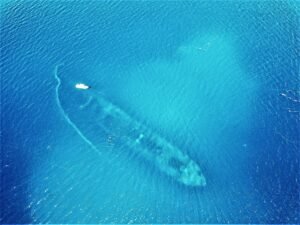
An aerial shot, taken in 2018, of the Fujikawa Maru.
The Fujikawa Maru also met its fate during World War II. However in this case, the Japanese vessel was sunk intentionally, in 1944, by the Americans.
Its resting place is in the Chuuk Lagoon, in Micronesian waters of the South Pacific, with the closest big country being Papua New Guinea. The wreckage is considered to be a premiere tourist attraction for a number of reasons.
First is it being well preserved, holding machinery, weapons and even disassembled fighter planes. The Fujikawa Maru was primarily a Japanese-military transport ship, albeit one also outfitted for combat. So it is rich in manufactured wartime resources from that era.
Also, as seems to be a common feature among large shipwrecks, diverse marine life have since made the ship their home. That is also counted as one of Fujikawa Maru’s major attractions.
You have to possess at least an Open Water diving certification to visit the exterior of the ship, and advanced certificates are required to explore the interior. The wreck isn’t terribly deep, with the top being at a depth of about 30 feet and then descending to 120 feet (i.e. 9-37 meters).
Local businesses are well aware of the appeal. This is one of the most-expensive dives on this list as, at minimum, you’ll be paying somewhere between $500 to $1,000. The standard is multi-day, multi-dive packages, which includes accommodation at a nearby hotel or resort. If you rather decide to live aboard and dive from a boat for a few days, that’ll cost you a lot more, in the range of about $4,000 per person.
HILMA HOOKER – BONAIRE
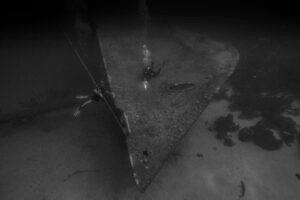
A section of the Hilma Hooker in 2019
The Caribbean is an aquatic region, lying in between North and South America, where a lot of drug trafficking goes on. Bonaire, which most people probably never heard of, is a Caribbean island belonging to the Dutch.
Those facts are significant to the history of the sinking of the Hilma Hooker. What happened, in 1984, is that the crew attempted to use the cargo ship to smuggle over 10 tons of marijuana. They got bagged by local authorities, and the vessel was docked as evidence. However, no one bothered to take care of it, as the owners were in hiding. So long story short, it eventually sank by natural forces, i.e. taking on too much water due to deterioration.
The crew and owners of the Hilma Hooker may have suffered a big loss, but it eventually went on, as a wreck, to become one of the Caribbean’s premiere diving sites. In the clear waters surrounding Bonaire, the wreck is visible from the surface. Also, you can swim to the site from land. Bonaire, in general, is a part of the world that divers favor, due to environmental factors. Also diving to the site (as a non-resident), all fees considered, only costs about $100.
RMS RHONE – BRITISH VIRGIN ISLANDS
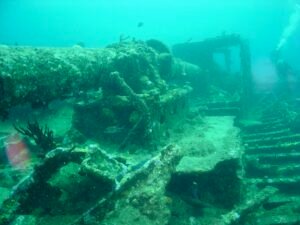
The RMS Rhone in 2003
And while we’re on the subject of the Caribbean, there’s another wreck in the area that has caught the attention of recreationists. That is of the Royal Mail Ship Rhone, a British vessel, which sank all the way back in 1867. It met its fate via hurricane, and unfortunately over 120 people died in the process.
In more recent times the wreckage, situated in the waters of the British Virgin Islands, has earned the lofty designation of a Protected National Marine Park.
You cannot swim to the RHS Rhone, but there are a couple of docks in the Virgin Islands which facilitate access by boat. The ship has deteriorated significantly, which is a good thing from a diving perspective, as you can view some of the large inner sections without actually going in. The ship’s depth ranges from about 30 to 9 feet (i.e. 9-27 meters). And it’s so large that organizers take visitors on two separate dives, with the second being deeper . Also, going to see the RMS Rhone isn’t overly experience, at about $65 per guided trip.
MV PANAGIOTIS – CYPRUS

A 2012 picture of the MV Panagiotis, stranded on a beach.
If, understandably, you’re not keen on diving into the sea, there are a couple of entries on this list that are completely visible from the surface.
It is not known or unanimously agreed upon how exactly the MV Panagiotis ended up permanently beached on the island of Zakynthos. But to note, even though it isn’t submerged, visitors are not allowed to go to the beach itself, due to the threat of landslides. And since there’s also a mountain behind the wreck, you won’t be getting a 360-degree view, nor will you be touching it. But you can safely view it from sea.
And that fact that you won’t be diving or anything like that makes this excursion the least expensive on this list, at about $40 per pop (if you’re traveling in a group).
EDUARD BOHLEN – NAMIBIA
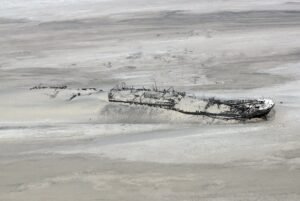
The Eduard Bohlen in Namibia, which is actually stranded in the desert.
If you make it to the Eduard Bohlen, it is one beached ship you can get close to actually touch. This is a German vessel which in 1909 ended up stranded in an area known as the Skeleton Coast, which is something to keep in mind as we proceed.
You see, even though it isn’t submerged, the Eduard Bohlen is still a largely inaccessible wreckage. It now sits half a mile from the shore. That did not happen because the ship was moved inland. Rather, the desert around has expanded, out into the sea. And the area surrounding the wreck is so inhospitable that trying to access it from the shore, unless you’re seasoned, confident expert, is a big, indisputable no-no.
The site can be accessed by road from further inland. But even that’s dangerous journey, requiring special permits and drivers thoroughly experienced in navigating the desert. So all things considered, i.e. being able to view the area in all its intimidating majesty will taking the least amount of physical risk, the preferred method is air. But to note, the plane will not actually land near the wreck.
So all things considered, visiting the Eduard Bohlen by road costs the same as a standard air trip, at around $300 per person. If however you decide to charter a private flight, then you’re spending closer to $1,000.
CONCLUSION
If you’re a thrill seeker, explorer, diver, etc. visiting a famous shipwreck can be a rewarding experience. As opposed to conventional tourist attractions, they may be more difficult to get to, but that’s part of what makes these experiences so unique.
Most of these wrecks are underwater and therefore require some level of previous diving experience or certification. The ones that are beached come with perils of their own, if you’re not overly cautious. We thank nature for preserving these large, historical artifacts. But as clearly illustrated, nature giveth, and it also taketh away.