Congo vs DR Congo: Maps, Borders and How Two Congos Emerged
| OFFICIAL NAME | The Republic of the Congo | Democratic Republic of the Congo |
| SHORT NAME | Congo or
Congo-Brazzaville |
DRC, DR Congo
or Congo-Kinshasa |
| CAPITAL | Brazzaville | Kinshasa |
| COLONIAL RULER | France | Belgium |
| INDEPENDENCE DATE | 15 August 1960 | 30 June 1960 |
| APPROXIMATE AREA | 350,000 sq. km.
or 130,000 sq. mi. |
2.35 million sq. km
or 900,000 sq. miles |
| POPULATION | 7 million | 117 million |
| OFFICIAL LANGUAGE | French | French |
| CURRENCY | CFA Franc (FAX) | Congolese Franc (DC) |
These two modern-day countries in Africa’s Congo Basic are direct products of European colonialism. One is the result of Belgian rule and the other, domination by the French.
Here is an outline of how the names of the Republic of the Congo and the Democratic Republic of the Congo have accordingly changed over time:
DEMOCRATIC REPUBLIC OF THE CONGO
CONGO FREE STATE (1885-1908)
BELGIAN CONGO (1908-1960)
FIRST CONGOLESE REPUBLIC / REPUBLIC OF THE CONGO (1960-1964)
DEMOCRATIC REPUBLIC OF THE CONGO (1964-1971)
REPUBLIC OF ZAIRE (1971-1997)
DEMOCRATIC REPUBLIC OF THE CONGO (1997-PRESENT)
REPUBLIC OF THE CONGO
FRENCH CONGO (1883-1910)
MIDDLE CONGO / FRENCH EQUATORIAL GUINEA (1910-1958)
REPUBLIC OF THE CONGO (1960-1969)
PEOPLE’S REPUBLIC OF THE CONGO (1969-1992)
REPUBLIC OF THE CONGO (1960-PRESENT)
So the Republic of the Congo and the Democratic Republic of the Congo are two separate countries. The DRC is the bigger one, leading into central Africa. It’s a former colony of Belgium.
The Republic of the Congo (without the “Democratic”) was a French territory. Those territorial divisions came about as a result of the Berlin Conference, aka “the Scramble for Africa”, when European colonial powers divvied up the continent.
THE ORIGIN OF THE WORD “CONGO”
The 14th century Kingdom of Kongo influenced the above-listed names. The Kongo are, more specifically, the people who dominated the land. And they are still around, in their numbers, to this day.
However, their dominance had waned significantly by the time colonization and the Transatlantic Slave Trade took place. The Congo basically became a resource supplier to the West. And that included human capital, as many African slaves who were exported overseas were captured from or transported through the Congo Basin.
So we don’t hear much about them directly these days. But the name has stuck around, with prominent locations being named after these people.
THE CONGO RIVER
For instance we have the Congo River, one of Africa’s greatest geographical features. Tthe name Zaire, which the DRC was briefly called, is also a reference to this river.
You wouldn’t notice it looking at a conventional map, but it’s actually the Congo River that serves as a natural border between the Republic of Congo and the Democratic Republic of Congo. And here’s an interesting fact. Brazzaville, the capital of the Republic of the Congo and Kinshasa, the capital of the Democratic Republic of the Congo, are less than five miles apart. They are both found in a particular section of the Congo River known as the Malebo Pool.
They are so close that if you look at an interactive map like Google Earth, Brazzaville won’t even appear unless you zoom in real close, as its basically in the same location as the more-prominent Kinshasa. They’re directly opposite each other, with Brazzaville to the north and Kinshasa to the south. Currently, there isn’t a bridge between the two cities. But getting from one to the other, by ferry, only takes about 20 minutes. That’s roughly the same time it takes to get from Manhattan to Staten Island by water.

Brazzaville, the capital of the Republic of the Congo and Kinshasa, the capital of the DRC, are situated just opposite each other in the Congo River’s Pool Malebo (aka the Stanley Pool).
It’s understandable why both countries decided to base their capitals in Pool Malebo. The Congo River boasts Africa’s “largest network of navigable waterways”. Or another way of looking at it is serving as a natural highway between a number of African countries. So it has stood – for centuries – as “the main commercial route” in Central Africa.
However, the roughly 200 miles between the Atlantic Ocean and Pool Malebo are not navigable. So the latter is where inland shipping begins. In other words, shipments are brought from the ocean to Pool Malebo by land and then transported, by the Congo River, to other parts of the continent – or vice versa.

A colonial map of Africa as of 1910. You will notice that by then, France (shaded blue) was in possession of what would become the Republic of the Congo, and Belgium (shaded purple) was in control of the DRC.

A present-day political map of the Congo Basin. Notice that the borders of the two Congos were defined by the preceding colonial map.
THE CRUEL RULE OF KING LEOPOLD II OF BELGIUM
Belgium’s King Leopold II (1835-1909) led the scramble for Africa. However, he did not do so on behalf of his country per se. Rather, the Congo Free State, under his rule, stood as “the world’s only private colony”.
The Congo Basin is not only extremely huge but also rich in resources. At first, Leopold II’s focus was on the extraction of ivory. Ivory was more valuable back in the days, before the advent of plastic. And later, he became preoccupied with exploiting the land’s rubber.

A map of King Leopold II’s Congo Free State, which would later become the Democratic Republic of the Congo.
Leopold II may also be credited with starting the modern trend of European colonizers sugarcoating their conquests by making it sound as if they’re rather serving mankind. He even had the nerve to dub the colony a “free state” and really convinced the world that his ambitions in Africa were humanitarian. When the international community found out the truth, that he was actually a ruthless conqueror, Leopold II was cancelled. But that did not prevent the Belgian chunk of the Congo from continuing to fuel Western economies. And Leopold II has since gone down in history as the personification of the brutalities of European colonialism in Africa.
FRENCH CONGO EQUALLY INHUMANE
France’s colonization of the Congo does not get as much historical attention, but they behaved just as inhumanely as the Belgians. For instance, the French Congo was for the most part divided between by private stakeholders. They answered to no one and were exponentially more preoccupied with profit than the well-being of the locals.
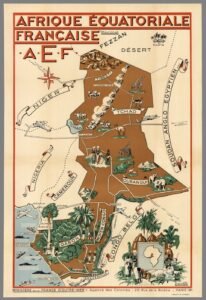
A map of French Equatorial Guinea, i.e. France’s early-20th century colonial holdings in Central Africa. Notice the Republic of the Congo – or more specifically Brazzaville – near the bottom.
This standard of committing some of the worst crimes against humanity in history was perpetuated not only due to the demonic greed of the colonial powers. But also, they did a good job of concealing the atrocities from the rest of the world, including their own citizens at home. This was well before the Information Age. News was controlled by the mainstream, and the average person couldn’t make their voice heard.
But during the early-20th century, it became known to the public that the French were treating Congolese people like animals – or even worse. Eyes were opened, and calls for reform were made. But as with the comparably-barbaric Belgian Congo, France’s colonialism in the region continued.
INDEPENDENCE TIME
Both the Democratic Republic of Congo and the Republic of the Congo achieved independence in 1960. In the aftermath of World War II, European colonizers lost their wherewithal to maintain foreign possessions. Also, the practice of colonialism itself was becoming increasingly unpopular.
The DRC officially became independent on 30 June 1960, and the process wasn’t easy. Civil war broke out. Belgium tried to retain de facto control, and masses of Belgian colonials were killed, in retribution for what they had done to Africans.
The country was also caught up in the Cold War, with the United States trying to stave off a growing Soviet influence. That dynamic is what ultimately led to the assassination of the legendary Patrice Lumumba, the inaugural Prime Minister of the First Congolese Republic, i.e. his fight against Western neocolonialism.
The Republic of the Congo eventually freed itself from French colonial rule on 15 August 1960, shortly after the DRC. A significant amount of bloodshed led up to the event, and they embraced communism even more than their neighbor. For a brief period of time shortly thereafter, the country was renamed the People’s Republic of the Congo, holding a place in history as “the first Marxist-Leninist state in Africa”.
CONCLUSION
Although they share a common history of brutal European colonization, co-depend on a mutual river and even had the same name for a brief period time, the Republic of the Congo and the Democratic Republic of the Congo are two different, albeit bordering, countries. Their differences lie, most simply put, in their colonial pasts. The Republic of the Congo was a French colony, was the Democratic Republic of the Congo stood as a massive, private Belgian holding. It is those differentiations, which transpired as a result of the Berlin Conference, that have defined the borders of these two countries.
FAQS
Are there two separate Congos?
Yes. There are two neighboring countries in Central Africa, both the word “Congo” in their name.
Why are they two Congos?
The Congo Basin was divided into various countries – including the Republic of the Congo and the Democratic Republic of the Congo – in the name of outlining European colonial territories.
Which Congo was Belgian?
The Democratic Republic of the Congo is a former colony that was privately owned by King Leopold II of Belgium.
Which Congo was French?
The Republic of the Congo is a former French colony.
Did the Republic of the Congo and the Democratic Republic of the Congo ever have the same name?
Yes. The First Congolese Republic, as the DRC was initially called when it gained independence, was also known as the Republic of the Congo. So during the early 1960s, the two countries had the same name.
Which Congo is bigger?
The Democratic Republic of the Congo, the second-largest country in Africa, is roughly seven times larger than the Republic of the Congo.
Are Kinshasa and Brazzaville close together?
Yes. Kinshasa, the capital of the DRC and Brazzaville, the capital of the Republic of the Congo, are less than five miles part, with both being situated on the Congo River.
Was the DRC called Zaire?
Yes. For a couple of decades during the late-20th century, DR Congo changed its name to Zaire.
Was the Republic of the Congo formerly the People’s Republic of the Congo?
Yes. For a couple of decades during the late-20thcentury, when the government embraced communism, the Republic of the Congo was known as the People’s Republic of the Congo.