10 Countries With More Than One Capital City
It’s a rare occurrence. But out of 195 countries in the world, nine have two capital cities. This can be caused by the government deciding it wants to move on from the past or other factors. And in one particular instance, there’s even a country with three officials capitals. (Spoiler alert: it’s South Africa).
BENIN
Benin’s constitutional capital is Porto-Novo. That’s where the country’s legislative and judicial branches are based. The de facto capital though is Cotonou, where the executive branch lies.
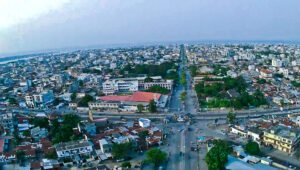
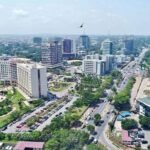
Cotonou, one of the capitals of Benin.
Porto-Novo has retained its longstanding status as the capital of Benin, dating back to the days of colonialism. However, upon achieving independence in 1960, the Beninese decided that their largest city, Cotonou, was also suitable, due to being a chief port and commercial hub.
BOLIVIA
Bolivia’s constitutional and judicial capital is Sucre. The more popular La Paz is the de facto capital, where the legislative and executive branches of government are situated.
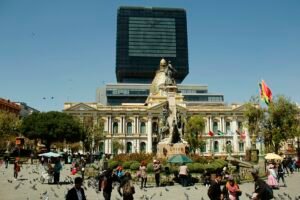
A scene from La Paz, Bolivia.
Bolivia’s two capitals are the result of domestic conflict and ultimately resolution. Two powerful mining industries, silver and tin, where respectively concentrated in Munce and La Paz.
Silver was the big thing at first, and accordingly, Sucre was initially the country’s capital. But later in the 19th century a civil war broke out, resulting in certain powers being transferred to La Paz. However, in the process Sucre was not stripped of its capital standing.
BURUNDI
Bujumbura is the commercial capital of Burundi, besides housing the government’s executive and judicial branches. The royal and political capital, however, is Gitega.
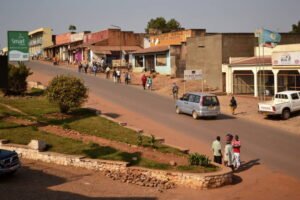
A common street in Gitega
The seat of the Kingdom of Burundi, which preceded the state, is located in Gitega. The Kingdom of Burundi preceded the Republic of Burundi and even defined the country’s current borders. But it wasn’t until 2019 that was it was made a modern capital, alongside Bujumbura.
ESWATINI
Eswatini’s executive and judicial branches are based in Mbabane, the administrative capital. It’s been the capital of the country since the days of British colonization.
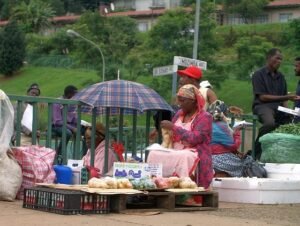
A woman with a humble fruit stall in Mbabane, Eswatini.
Lobamba, meanwhile, is the nation’s historical and cultural center. This is where laws are made, and it became a capital in 1968, when Eswatini, formerly known as Swaziland, was liberated. And to note, it is only about 18 kilometers (11 miles) from Mbabane.
IVORY COAST
The Ivory Coast’s economic center and de facto capital is Abidjan. But the administrative powers are centered in Yamoussoukro, which is also the symbolic capital.
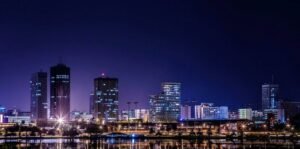
The well developed capital city, Abidjan, in the Ivory Coast.
Long story short, the man who led Côte d’Ivoire (aka the Ivory Coast) to independence and served as its first president, Félix Houphouët-Boigny, decided to make his hometown, Yamoussoukro, a capital. Originally being an obscure village, it’s wasn’t suited for such responsibility. But in the president’s defense, he was personally committed to developing Yamoussoukro, besides blessing the ‘hood with government resources. The longer-standing, proper capital is Abidjan, and that’s how it’s generally viewed.
MALAYSIA
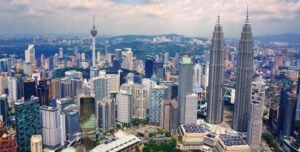
Malaysia’s royal capital, where the monarchy is based and laws are made, is Kuala Lumpur. The less-popular Putrajaya is the administrative capital, housing the judicial and executive branches.
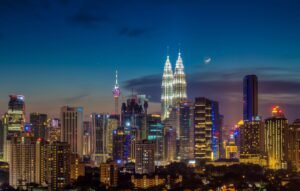
Kuala Lumpur, Malaysia
Malaysia is an interesting case. Like some other country’s on this list, it’s most-popular capital, Kuala Lumpur, was founded during colonialism. But by the 1980s, congestion in the city was so bad that the government decided to create an entirely new one, about 20 miles away, from scratch. That was Putrajaya. And, as planned, it went on to become a co-capital.
NETHERLANDS
The Hague has never officially been the capital of the Netherlands, but it is so in the de facto sense. This is where the seat of government has been set going all the way back to the 16th century, to the days of the preceding Dutch Republic. The Hague where the three main branches of government – executive, judicial and legislative – are set.
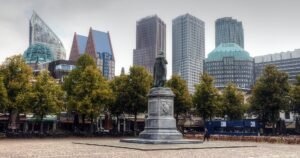
The Hague (pictured above) is the other capital of the Netherlands, besides Amsterdam.
The Kingdom of the Netherlands, i.e. the monarchy, achieved independence during the early-19th century and chose Amsterdam as its constitution capital. So the monarchy is based in Amsterdam. But the actual government, if you will, remains centered in the Hague.
SRI LANKA
Colombo, which houses the government’s legislative branch, has been the official capital of Sri Lanka for over two centuries, going back to 1815. But in 1977, Sri Jayawardenepura Kotte was designated as the de facto capital, having since been responsible for the judicial and executive branches.
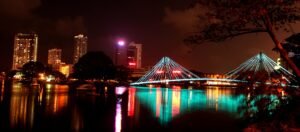
The Beira Lake in Colombo, Sri Lanka
After Sri Lanka gained independence in the late 1940s, the government in Colombo grew fast – so fast that within three decades, the government decided to share its capital responsibilities with Sri Jayawardenepura Kotte.
TANZANIA
Dar es Salaam is the de facto capital of Tanzania, first being recognized as such by colonial powers in 1891. The legislative branch is headquartered here. The judicial and executive, however, have since found a home in Dodoma, beginning in 1996.
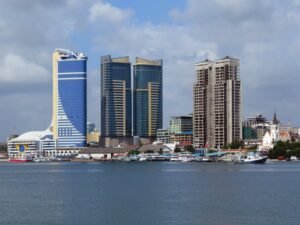
Dar es Salaam, the longer-standing capital of Tanzania
The capital situation in Tanzania has been in a state of transition for decades. The country’s first president, Julius Nyerere, was a freedom fighter. So his government wanted to do away with the colonial legacy by shifting the capital from Dar es Salaam to a location inland, Dodoma, that was better suited for the Tanzanian everyman.
That decision was first made back in 1973, but things have not progressed as idealized. The development of Dodoma has proceeded at an uninspiring pace, and a number of government offices and foreign embassies doggedly prefer Dar es Salaam.
SOUTH AFRICA
South Africa is the only country in the world that has split its legislative, official and judicial branches into three separation locations. And that decision, which was made in 1910, had nothing to do with spreading the government amongst the people.
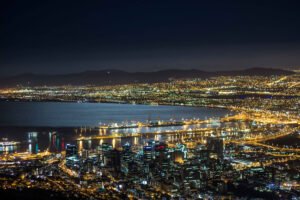
Cape Town, the most-popular of South Africa’s three capitals
Rather, there were two competing colonial powers, the English and the Boers (i.e. Dutch), who formed the modern state of South Africa. And part of their agreement was instead of centralizing the government in one party’s territory or the other’s territory, Cape Town (English) would be the legislative seat, Pretoria (Boer) the administrative and a neutral location, Bloemfontein, the judicial.
CONCLUSION
Countries that have two capitals do so for their own respective reasons. For a few it is part of the liberation process, to symbolize or embrace independence. Others may be compelled due to the older capital being over capacitated. And in other countries, having more than one capital can be a compromise amongst competing powers.