10 Deadliest Plane Crashes in History
In this post, we will look at the 10 worst aviation disasters, in terms of lives lost, in world history. Half of the entries on this list may be blamed on aviation professionals, such as pilots, air traffic controllers or maintenance crews. But the other half, sadly enough, were intentional, resulting from acts of terrorism or attacks by hyper-aggressive militaries upon civilian aircraft.
You may immediately notice that the notorious September 11 attacks were not included in this list. That is very intentional. But why? Simply because although four commercial airliners were hijacked on September 11, 2001, and nearly 3,000 people ultimately lost their lives as a result of that, we have chosen to treat the tragic incident separately because the aircraft themselves were deliberately turned into weapons.
This distinguishes the attacks from incidents such as Air India Flight 182 and Pan Am Flight 103, where bombs destroyed passenger aircraft, or Malaysia Airlines Flight MH17 and Iran Air Flight 655, where civilian aircraft were shot down. September 11 unquestionably changed aviation forever, most importantly when it came to airport and aircraft security. But its nature, scale and wider consequences extend far beyond an aviation disaster. Owing to that it is a subject that deserves its own discussion.
So with that distinction out of the way, let us now delve into the 10 aviation disasters that claimed the greatest number of lives and examine what happened. We shall also look at what went wrong and, where applicable, how they changed air travel afterward.
TENERIFE AIRPORT DISASTER (583 Deaths) – SPAIN
On 27 March 1977, at Tenerife North (formerly Los Rodeos) Airport, a number of factors, natural and some manmade, led to aviation catastrophe. First of all Los Rodeos, which had only one runway, did not possess the size or wherewithal to host heavy traffic. But this particular day proved unusual in that there was a terrorist threat at an airport on a nearby island. That is what caused the two large jets that were eventually involved in the accident to land at Los Rodeos to begin with.
Fate would also have it the airport that was blanketed with a thick fog. It was so concentrated that air control lost sight of the jets as they were on the runway. That’s how nature played a role.
And then, there were communication issues between the air traffic controller and the pilots. The former spoke with an accent that made it difficult for the latter to comprehend what he was saying. And to make a long story short, the planes ended up colliding.
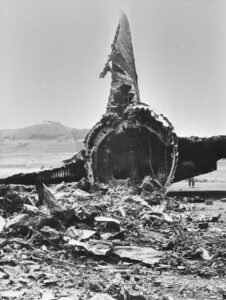
The Tenerife airport disaster involved two Boeing aircraft, one from the Netherlands and the other from the United States. This pic shows part of the wreckage of the latter.
This incident, which didn’t even occur in the air per se, remains the deadliest aviation accident in history – a record that has now stood for nearly 50 years. Nearly 600 people (583 people to be precise), between both planes, lost their lives. In terms of body count, no airplane disaster outside of 9/11 has been as tragic.
The good news is that the disaster did lead to some safety reform within the industry. Miscommunication, which proved to be the biggest factor in the accident, was minimized by removing ambiguity or words that could easily be misheard (most specifically “takeoff”) from the aviation lexicon. Also, first officers on flight crews were empowered to challenge the captain if he made questionable decisions.
JAPAN AIRLINES FLIGHT 123 (520 Deaths) – JAPAN
Approximately 520 people tragically lost their lives in this incident, and there was only one aircraft involved. That’s what makes the Japan Airlines Flight 123 disaster, which occurred on 12 August 1985, the worst single-plane accident in aviation history.
In summation, the aircraft was involved in a previous incident whereas its tail was damaged. That issue was rectified by technicians from Boeing, the manufacturer of the plane – or so they thought. And keep in mind, these repairs took place in 1978.
The technicians, most simply put, did not do a good job. The aircraft remained in operation, with the section that had been inadequately repaired, the aft pressure bulkhead, gradually deteriorating. So on 12 August 1985, some seven years later, the part of the plane exploded, while it was in the air, with 15 crew members and over 500 passengers onboard. It just so happened that they decided to outfit the craft with “a high-density seating configuration”, giving it the capacity to carry more people.
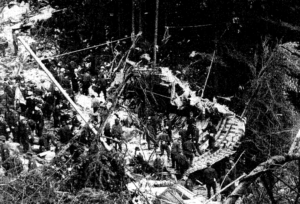
Rescue workers looking for survivors amongst the wreckage of Japan Airlines Flight 123.
So by the time all casualties were accounted for, 520 people were dead, and only four survived. After the explosion, Japan Air Lines Flight 123, which was on a domestic flight, crashed near a mountain outside of Tokyo. The flight crew, try as they might, could not avert the disaster.
The silver lining is that the carnage eventually led to reforms to prevent this kind of thing from happening again. Airplane maintenance inspections were taken more seriously. There were also changes made to fortify hydraulic systems. And interestingly, in 1989 an airplane in the United States faced a similar issue and was able to use the lessons learned from Japan Air Lines Flight 123 to prevent another disaster.
CHARKU DADRI MID-AIR COLLISION (349 Deaths) – INDIA
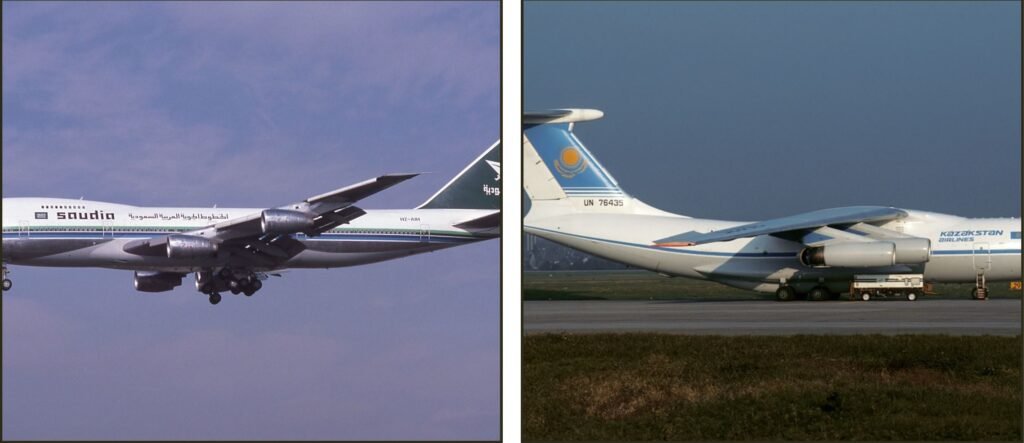
The two aircraft involved in the 1996 Charkhi Dadri mid-air collision: Saudia Flight 763, a Boeing 747, on the left, and Kazakhstan Airlines Flight 1907, an Ilyushin Il-76, on the right.
Now, we’re turning back to another aviation accident which unfortunately involved more than one plane. On 12 November 1996, a Boeing jet from Saudi Arabia and a cargo plane form Kazakhstan collided in the skies over the state of Haryana, approximately 60 miles outside of the Indian capital of New Delhi. They made impact at a height of about 4,230 meter (i.e. 14,000 feet). The Indian plane was carrying 312 souls, while there were 37 occupants in the Kazakh airlifter. No one survived.
The good news, if you will, is that the collision happened so fast, at a speed in excess of 1,000 miles per hour, that the victims were likely gone before realizing what happened. The reason the combined force of the two planes equaled such a high impact or closing speed is because they met each other head-on, in the air, if you can imagine that.
The tragedy was, in essence, the fault of the Kazakhs. The two planes, as instructed by air traffic control, were supposed to be a good 1,000 feet away from each other in altitude. But the one from Kazakhstan, in error, descended too far. And what has been concluded is that the pilots likely did not rightfully understand the English-language instructions coming from air traffic control.
But there were also technical factors involved. In computing altitude distance, the Kazakhs were doing calculations in meters, while the world standard is rather in nautical miles and feet. Furthermore, the equipment air traffic control was using at Indira Gandhi International Airport was outdated, i.e. unable to identity individual aircraft and calculate attitude.
And the biggest issue on part of Indian aviation officials was civilian planes coming in and out of the airport using a single corridor. Metaphorically, it’s like putting two-way traffic on a one-lane road. Of course that’s far from ideal and not the norm that airports practice. But they did so at Indira Gandhi, as the rest of the air was being used by the Indian military. And lastly, neither plane was equipped with a collision avoidance system, that are specifically designed to warn of and prevent mid-air collisions.
The government of India subsequently repented by requiring all planes coming into or leaving the country to have a collision avoidance system. And it was that decision that later led to such equipment becoming standard around the world.
Also, they no longer allowed aircraft coming in and out of an airport, i.e. going in two different directions, to share the same corridor. Moreover, the Indian Air Force had to tighten its reins in terms of how much airspace they were allotted. And in the aftermath of this tragedy, the aviation industry across the world began adopting English as its standard language, thus making a certain level of fluency amongst parties involved in directing and facilitating air traffic mandatory.
TURKISH AIRLINES FLIGHT 981 (346 Deaths) – FRANCE
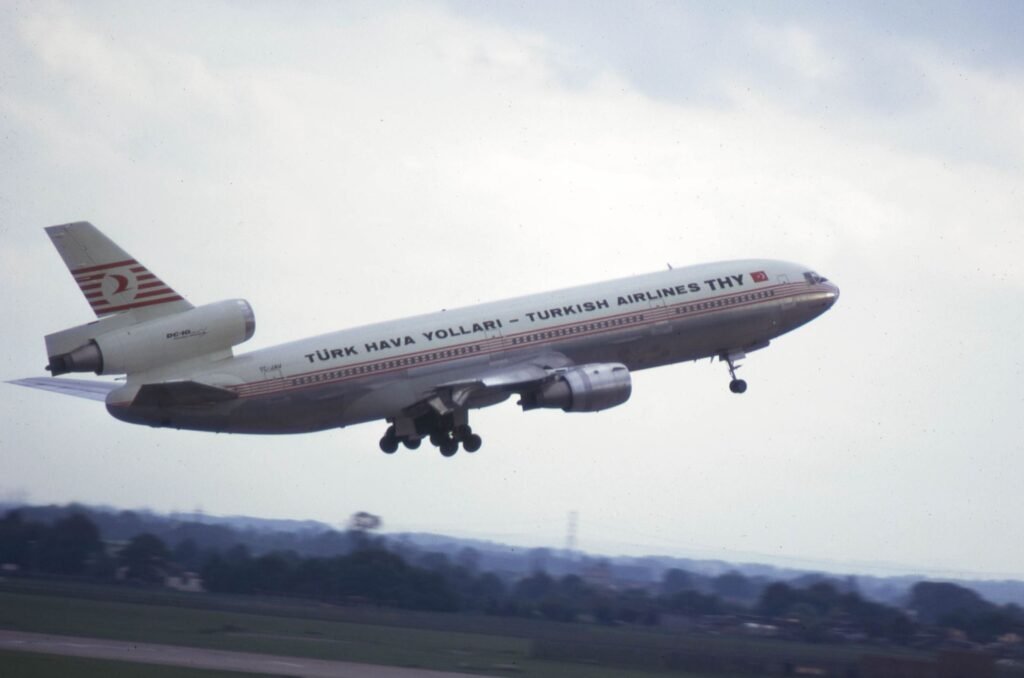
This is a picture of the particular aircraft that was involved in the disaster. The picture was taken somewhere in 1973.
This flight was on its way from Istanbul to London, with a stopover in Paris. Under conventional circumstances, it wouldn’t have been carrying so many passengers. But there were a couple of things going in England, such as employees striking at British European Airways, which caused Turkish Airlines Flight 981 to be transporting nearly 350 people when it met its fate.
That occurred, more specifically, on 3 March 1974. Every accident on this list is heartbreaking, but this one was truly bloodcurdling, as most of the victims lived through sheer horror during their final seconds.
What happened, most simply, is that one of the plane’s cargo doors, which was faulty from manufacture, became detached, at a high altitude, from the rest of the aircraft. And like we often see in movies when an airplane loses a door, the depressurization proved catastrophic, including six passengers being sucked out into the sky.
This was followed by a number of mechanical failures and the pilots losing control. Within less than two minutes after the door blowing off, the plane crashed into a forest. The pilot opted to speed up the craft in a futile attempt to keep it in the air. And that contributed to it ultimately hitting the ground at a speed of nearly 500 miles.

A monument memorializing the victims of Turkish Airlines Flight 981 in France’s Ermenonville Forest, where it crashed.
So absolutely no one survived. In fact, Turkish Airlines Flight 981 hit the ground with such force that it disintegrated. The corpses of over 100 of the dead were unidentifiable, as the victims’ bodies were collectively fragmented into 20,000 pieces. So even to this day, over 50 years later, this incident stands as the deadliest aviation disaster involving a single plane with no survivors.
The industry took notice and made modifications accordingly. Planes began being designed so that if they did become depressurized, they could still remain airborne. And McDonnell-Douglas, the company that manufactured the plane involved, upon being successfully sued for millions of dollars made upgrades to the latches and locking systems of their doors.
AIR INDIA FLIGHT 182 (329 Deaths) – OFF THE COAST OF IRELAND
This is another calamity that resulted from in-flight depressurization, i.e. a hole in the plane. However, unlike Turkish Airlines Flight 981, this was not an accident.
In 1985, Air India Flight originated in Canada and was destined for India, before making a transit stop in London. However, it never reached Europe. Instead, the plane exploded above the Atlantic Ocean, off the coast of Ireland, about 45 minutes away from England.
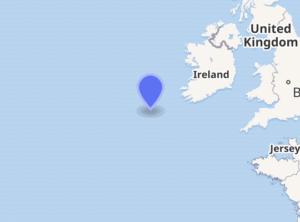
A marked map showing where Air India Flight 182 exploded over the Atlantic Ocean, southwest of Ireland.
What happened, more specifically, is that a bomb planted on the craft exploded. And the interesting things is that, before leaving Canada, officials actually removed some packages they deemed suspicious. However, they missed the bomb itself, and it ended up claiming 329 lives, i.e. everyone on board, apparently in an instant.
It took a couple of decades, but a (relatively-mild) conviction was finally handed down to one of the masterminds, a British-Canadian citizen who was originally from India, in 2003. They were down with a fundamentalist Sikh terrorist organization known as Babbar Khalsa, whose goal is to basically secede from India. In other words, they have beef with the Indian government, which was especially true circa the 1980s. And at the time of the bombing, Air India was a government-owned entity. And to note, the overwhelming majority of the victims of Flight 182 were of Indian descent but simultaneously being Canadian.
Canadian authorities were able to trace the bomb back to Babbar Khalsa and more exactly two individual suspects in Canada, as they planted another one on a separate Air India Flight. But that explosive, thankfully if you will, only ended up taking the lives of two airport employees in Japan.
This was not a suicide attack. The planter of the explosive was not on the plane. He checked the suitcase holding the bomb in alright but never boarded the flight.
So since then, Canadian authorities have implemented a rule whereas baggage is not allowed onto a plane if the person who checked it in isn’t also on board. They also got more serious about the utilization of x-ray and other airport security technologies. And besides that, it has been argued that intelligence agencies did not properly handle foreknowledge of an attack and related information. So this disaster also resulted in Canada stepping up its game in national and airport security.
All of that unfortunately being said, with well over 300 lives lost, Air India Flight 182 remains the greatest aviation disaster caused by terrorism outside of the 9/11 attacks.
SAUDI FLIGHT 163 (301 Deaths) – SAUDI ARABIA
This is by far one of the oddest tragedies on this list. In 1980, a total of 301 people – everyone on board the plane, crew and passengers alike – lost their lives. However, they did not die as the result of a crash, bomb nor in the air. Rather, it was from smoke inhalation.
Saudi Flight 163 was on a domestic voyage. Less than 10 minutes after taking off from what is now known as Jinnah International Airport, the crew received warning of smoke on the aircraft. It took them four minutes to verify that they was indeed a fire, upon which they decided to return to Jinnah International, which thankfully wasn’t that far away.
However, calamity proceeded to ensue nonetheless. For reasons that have yet, if ever, to be conclusively determined, the captain decided to run the entire length of the runway, keep the engines on and failed to order an emergency evacuation. All facts considered, including the crew’s sluggish response to the initial warning signs, the logical implication is that they underestimated the fire. Apparently, this was yet another case, like the Tenerife airport disaster, whereas the captain, in exerting this authority, may have made fatal, preventable decisions in his hubris. And indeed, as mentioned earlier, it wasn’t the fire itself that claimed all those lives. Rather, it was smoke inhalation, though the flames did proceed to pretty much consume the aircraft also.
That was made possible, once again, by the fact that the plane traversed the entire runway, i.e. further away from emergency services. And by the time fire rescue did arrive, even though the crew reported its intent to shut down the engines they didn’t, thus preventing first responders from getting the doors open.

The appearance of Saudi Flight 163, after it was ravaged by fire.
In the aftermath, Saudi Flight 163 led to Jinnah International reevaluating and buttressing its emergency protocols. And Lockheed, the manufacturing of the plane, instituted changes to make the cargo area of the aircraft, where the fire broke out, less flammable.
This incident also led to industry-wide changes whereas the captain of aircraft no longer had autocratic rule if you will, with a team-based approach to leadership rather being embraced.
MALAYSIA AIRLINES FLIGHT M17 (298 Deaths) – UKRAINE
Unlike the other entries on this list, this one happened pretty recently, so you may even remember it from news headlines. And what makes it unusual is this being the crash of a civilian plane caused by a missile strike.
What has been concluded is that Malaysia Airlines Flight M17 was shot down, most simply put, by the Russian military, via the use of a surface-to-air missile. However, they didn’t do it intentionally per se.
It is virtually unheard of for a military to shoot down a civilian aircraft. But to note, this incident happened on 17 July 2014, i.e. a couple of months after the onset of the Russo-Ukrainian War. So what happened apparently, the official conclusion, is that the Russian military mistook Malaysia Airlines Flight M17 for a transport aircraft belonging to their Ukrainian rivals. It’s truly a sad, confusing affair as to the this day, Russia has yet to accept responsibility for the attack.
The missile did not make direct impact with the plane but still detonated closely and powerfully enough to kill three members of the crew in the cockpit and proceed to tear the aircraft apart. It didn’t explode per se but rather proceeded to gradually and rapidly disintegrate as it descended.
There were no survivors amongst the nearly 300 onboard, making this the deadliest aviation disaster in history that was caused by a plane getting shot down. And note that 2014 was also the year that Malaysia Airlines Flight 370 disappeared from the face of the Earth. So it definitely wasn’t a good year for the company.
As far as adjusting regulations are concerned, there’s really only so much you can do to prevent a military from shooting down a plane. They have to be intelligent and humane enough not to do that on that own accord.
But that said, the industry did subsequently embrace the standard of airlines themselves being more vigilant in terms of avoiding airspace in areas where there’s conflict. And countries also began collaborating to speed up intelligence amongst themselves that may prevent such instances into the future.
IRAN FLIGHT 655 (290 Deaths) – IRAN
Unfortunately, we are grieved to report yet another mass-casualty aviation event that was the result of a military shooting down a plane. In this case, the perpetrator was the United States, and, perhaps unsurprisingly, the victim was Iran. As of this writing, in late 2026, the U.S.is engaged in a months’-long invasion of Iran. However, this is not the first time they have gone at it, i.e. the American military being situated in Iranian waters.
This incident occurred on 3 July 1988, concurrent with the Iran-Iraq War. The U.S. was unofficially involved or intervened in that conflict, on behalf of Iraq. That would help explain why the U.S. navy warship that shot down Flight 655 was in the Strait of Hormuz and compelled to attack an Iranian aircraft to begin with.
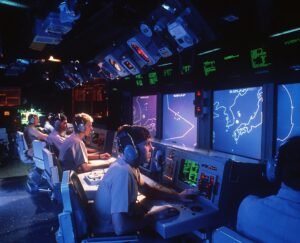
The combat information center, i.e. the brain, of the USS Vincennes, where the decision was likely made to shoot down Iran Airlines Flight 655.
In defense of said warship, the USS Vincennes, it was actually under attack, by Iranian speedboats, when this incident occurred. That contributed to them concluding that Flight 655 was a military aircraft more hastily than they would have otherwise. Besides that, the plane had just departed from Bandar Abbas International Airport, which was used for both civilian and military purposes.
There were also communication lapses between the USS Vincennes and Flight 655, when the former was trying to ascertain if the latter was an innocent aircraft or not. It’s hard to ascertain exactly what happened. But, by the looks of things, the crew of Flight 655 never thought they were in any type of danger.

A postage stamp issued in Iran in the aftermath of the attack.
They did not receive warnings emitted over military channels, because it was a civilian plane that was not set to such frequencies. Nor did the USS Vincennes have the standard equipment to monitor civilian radio. And as for the warnings they did transmit via civilian channels, the conclusion is that the crew of Flight 655 thought the U.S. military was referring to another aircraft, not their own.
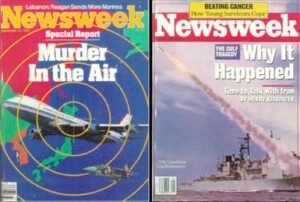
Even Newsweek, an American publication, referred to the attack on Iran Flight 655 as “murder in the air”.
In any event, the plane was shot down under questionable circumstances. Even though warnings were not heeded, logic probably should have dictated to the command of the USS Vincennes that Flight 655 was not aggressive. Also, as perhaps to be expected, the U.S. military never actually apologized or took responsibility for the event, though they did dole out a few million dollars to the victims’ families.
In the aftermath, the international community went about streamlining communications between civilian and military aircraft, to prevent the possibility of such confusion happening again.
AMERICAN AIRLINES FLIGHT 191 (273 Deaths) – UNITED STATES
Needless to say, large passenger planes are extremely heavy, often weighing well over 100 tons, besides being made up of thousands of pieces. So in the event that one experiences an in-air catastrophe, sometimes people on the ground catch it also.
Everyone aboard Flight 587, 271 passenger and 13 crew members, met their fate on 25 May 1979. The plane was headed from Chicago to Los Angeles, when an engine detached immediately upon takeoff.
You would think that the pilots would then simply abort the flight, but it’s not that simple. By that point, they were already traveling at a speed where they had to takeoff nonetheless.
Besides that, the crew did not know that the engine had actually fallen off and rather thought it had failed, so they followed procedure, i.e. decelerated, accordingly. That caused the left wing, from which the engine had fallen off, to stall completely, which then resulted in the crash.

The fireball that resulted from the crash of American Airlines Flight 191, just outside of O’Hare International Airport in Chicago, Illinois.
Adding to the misfortune was two people working nearby, who weren’t even on the plane, dying as a result of falling debris, with another two men being severely burned yet surviving. And with such a high overall death toll, this tragedy has stood throughout the years as the deadliest aviation accident on U.S. soil.
What was ultimately concluded, as in what caused the engine to detach, was American Airlines, in the name of saving money and man hours, not taking the maintenance of their DC-10s (i.e. the type of plane involved in this accident) as seriously as they should. But unfortunately for McDonnell Douglas, the manufacturers of that plane, investigations only came to that conclusion after the company had took a beating in the mainstream media.
So by the time all was said and done they were forced, alongside American Airlines, to compensate the victims’ families to the tune of tens of millions of dollars. But in terms of fines from the Federal Aviation Administration (FAA), American Airlines faced that alone.
The FAA also mandated that airlines could no longer alter maintenance procedures as stipulated by the manufacturers of planes, as American Airlines was doing with it DC-10s, without approval from the FAA itself. They also introduced sweeping structural mandates so that if an engine fell off, the warning would be properly registered in the cockpit, and the plane would not experience catastrophic failure, as was the case with Flight 191.
PAN AM FLIGHT 103 (270 Deaths) – SCOTLAND
I still remember when this incident occurred and totally dominated news headlines. I was residing in the U.S. at the time and now looking back, while researching Pan Am Flight 103, I can understand why.
First of all the flight, which originated in Germany, was headed to the United States. Accordingly most of the fatalities, 190 out of the 270 in total, were Americans, including a number of students from New York’s Syracuse University.
Second, this wasn’t some accident caused by mechanical failure or error on the part of aviation professionals. Rather, it was a bombing, which was eventually linked to Mukhabarat el-Jamahiriya or, put more bluntly, the government of Libya.
Third, the plane exploded in the skies over Lockerbie, Scotland, i.e. a populated town. So by the time all the debris had descended, 11 people on the ground ended up dead also.
The one Libyan national who was convicted of this crime, i.e. murdering 270 people, was originally sentenced to life and prison in 2001. But eventually he got off with a slap on the wrist, being acquitted just eight years later, after it was discovered he had cancer, and he died shortly thereafter.
But with that said, it should be noted that Muammar Gaddafi, i.e. the leader of Libya, did compensate the victims’ families to the whopping tune of nearly $3 billion, at an average of $10 million per family. As you can glean from this list, that’s a whole lot more than Western agencies tend to pay out when they’re responsible for aviation disasters. And in a nutshell, that massive amount was necessary to keep Libya within good standing with the international community.
Between Germany and the USA, Flight 103 had a stopover on London. That is where the bomb, which was concealed in a suitcase, was loaded onto the plane. And get this – the suitcase itself originated in Malta, before making its way to Germany and onto the aircraft. Meanwhile, the person who planted the bomb was nowhere to be found.
So as with Air Flight India 182, which was sabotaged in a similar matter, in the aftermath of American Airlines Flight 183, reforms were made so that bags were no longer allowed onto airplanes without the person who checked it in also being physically onboard. But unlike Air India Flight 182, in the wake of the Lockerbie disaster these rules were instituted internationally.
The bombing also opened the eyes of the international community to the fact that airport security technology needed to be upgraded, and more collaboration between governments, particularly the U.S. and U.K., was deemed necessary. Also, the U.S. government created a couple of new internal organizations, specifically tasked with beefing up the nation’s aviation security.
CONCLUSION
You always hear people say that air travel is safer than traveling by road, which is factually true in terms of the amount of fatalities. But there are obviously more things that can go wrong with an aircraft. If maintenance isn’t taken ultra-seriously, professionals make an error, a bomb is planted or a plane is attacked, the ramifications can prove history-changing in terms of how they affect the aviation industry. In other words, airplane crashes are indeed rarer, but they tend to result in more fatalities. But it is from these selfsame disasters that air travel has become safer or more secure throughout the years.