The Kuril Islands Dispute Between Russia and Japan
The Kuril Islands are a series of landmasses that collectively stretch from northeast Japan to Russia’s Kamchatka Peninsula. Japan and Russia do not share a border on land, but they are maritime neighbors.
Unfortunately, the modern history between these two nations has been highlighted by warfare and tension. Japan has become more aligned with Russia’s rivals in the West, and there is longstanding territorial beef over the Kuril Islands.
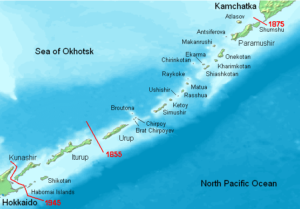
The entirety of the Kuril Islands, situated between Japan in the south and Russia in the north.
RUSSIA GRANTED SOVEREIGNTY OVER THE ISLANDS (OR SO IT THOUGHT)
The Soviet-Japanese War of 1945 was one of many horrifying battles that defined World War II. This occurred during the tail end of WWII, after Germany had already been defeated and following the bombing of Hiroshima. The United States proceeded to drop another atomic bomb on Japan, on 9 August 1945, the day after Russia launched its invasion. The Japanese were in a weakened state, and being bested by the Russians contributed to their decision to bow out of World War II.
As a result of the defeat, Japan was basically forced to concede its share of the Kuril Islands. It’s a very complicated situation, dating back to treaties signed in the 19th century, as well as a number of agreements that were ratified circa WWII. But long story short, after emerging victorious in its most-recent war with Japan, Russia was granted administration over the Kuril Islands. This occurred partially through the San Francisco Treaty of 1951, when the Japanese were forced to renounce their ownership of the islands.
SO WHAT’S THE FUSS?
As pointed out by many sources, the San Francisco Treaty does not actually recognize Russia’s sovereignty over the Kuril Islands. That idea was rather agreed upon, it would appear, during the Yalta Conference of 1945. And to note, Japan was not party to the latter. It was rather an agreement made between Russia, the United States and the United Kingdom, i.e. the Allied Forces of WWII.
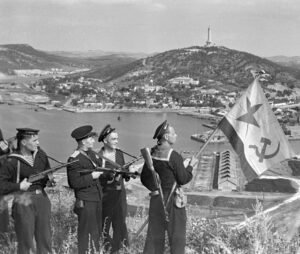
A scene from the Soviet-Japan War, fought towards the end of World War II, symbolic of Russian victory.
You may recognize those three countries as the biggest victors of World War II. Russia came out of that conflict as the undisputed superpower of the East. The Russians did not sign the San Francisco Treaty, due to aforenoted lack of recognition of their sovereignty over the Kurial Islands. But they’ve had the wherewithal to exert their dominance, at least to some extent, nonetheless.
The problem lies in the four disputed islands (out of roughly 50 in total) being those closest to Japan. More specifically, they are Iturup, Kunashiri, Shikotan and Habomai.
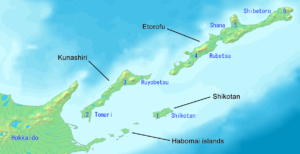
The four disputed Kuril islands, i.e. those closest to Japan.
According to the Japanese, they are not part of Kuril per se but rather an extension of their northern mainland. Meanwhile, as also pointed out by Wikipedia, even though the short-lived Soviet-Japanese War officially concluded in 1956, the parties “did not sign a peace treaty”. And by the looks of things, that’s in large part due to these selfsame island remaining a point of contention.
SO MUCH TROUBLE IN THE WORLD
It’s possible that you never heard of the Kuril Islands’ dispute. Even for those of us who keep up with the news, bigger Pacific beefs, such as the South China Sea turmoil, tends to dominate headlines.
Indeed, Russia never appeared to be overly keen on exerting its statutory dominance over all of the islands. But in recent years, the rhetoric of the Russians and Japanese concerning the matter has taken a concerning turn.
The four disputed islands are just a stone’s throw away from mainland Japan. So it’s more understandable why the Japanese wouldn’t want a foreign nation, especially one it has a violent history with, controlling them. And the situation is such that, all it takes is a few words, a visit or even a map rendering from a prominent political entity to fan the flames.
PUTIN VISITS ITURUP IN 2026
For instance, on 13 August 2026 ,the Russian President himself, Vladimir Putin, decided to take a tour of Iturup, visiting a hospital, school and food plant. It’s quite telling that he decided to go to that particular island, i.e. a disputed one, considering that it was the first time Putin, whose been in power for over 20 years, even bothered to go to Kuril.
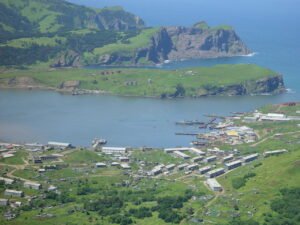
Some parts of the Kuril Islands are notably populated, such as this scene from Shikotan.
His visit didn’t sit well with the Japanese government at all. The Prime Minister responded by calling Putin’s actions “absolutely unacceptable”. She went on further to chime that the Russian President “worsened Japanese sentiment towards Russia”. Those are very strong words coming from such a powerful politician. And this is besides Russia’s ambassador in Tokyo being subsequently ‘dressed down’, i.e. insulted.
THE UNITED NATIONS’ EQUAL EARTH MAP
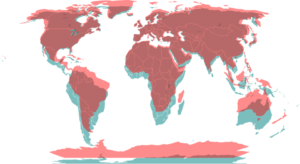
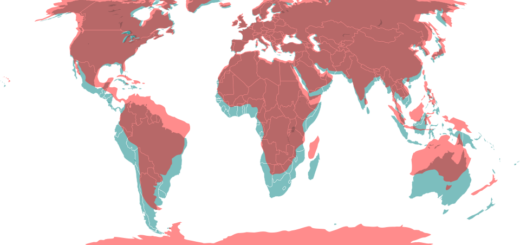
Then, less than a month later, the United Nations resolved to stop using the Mercator world map. Instead, they’ve adopted a more recent development known as the Equal Earth projection. And their version implies that the Kuril Islands belong the Russia.
As you would expect, this pissed the Japanese off also. They didn’t have a problem with the adoption of the map as a whole. But what they did speak out against is the above-mentioned implication.
WHY DOES RUSSIA EVEN CARE ABOUT THE ISLANDS
It may seem strange that the Russians are preoccupied with these small islands next to Japan. But what it basically boils down to is food resources and military advantages.
More specifically, the waters in the area are rich in fish. In fact, that aforementioned food facility Putin toured in Iturup was actually a fish-processing plant.
Secondly, holding the islands is advantageous to Russia’s navy in the Pacific. That part of the world, as you may already know, is quite cold. But as pointed out by The Guardian, “the strait between the southern islands does not freeze in winter”.
Meanwhile, whereas the Pacific Ocean is to the east of the islands, the Sea of Okhotsk is to the west. And by looks of things, said waterbody marks the shortest transit between southern Russia and the Pacific Ocean.
So Russia did respond to that outburst by the Japanese Prime Minister. And in summation, as agreed to during WWII in their opinion, the Kuril Islands are indeed Russian territory.
CONCLUSION
Japan took a big L in World War II, and part of the subsequent deals included its forfeiture of the Kuril Islands. However, the Japanese does not consider the four closest to their mainland as actually being part of Kuril.
All things considered, perhaps that should made that stance clearer 80 years ago. As it currently stands, the ever active Russian military is significant ramping up its presence on the islands. They’ve setup some big time defenses, besides using the area for major military drills, to the dismay of Japan.
In a perfect world, the two parties would be able to come to an amicable resolution. But considering history, as well as all that’s at stake, what’s more likely to occur is related tensions escalating, as the Russian military continues its expansion into the Kuril Islands.


1 Response
[…] shading of the map implies that the Kuril Islands belong to Russia. But politically, there is an ongoing dispute between the Russians and Japanese over that territory. Likewise, India is favorable of Equal Earth adoption but is concerned about how an area it is […]