5 “Facts” About Living in Africa
I’ve resided in Africa – specifically Ghana – for almost a quarter century and have learned a lot about living over here. Being originally from the States, the transition was far from easy. I suffered from lack of knowledge and preparedness. But my real world experience have qualified me to advise others who may decide to take the leap.
In any event, this post isn’t meant to be super serious. Maybe you’re just curious about how life is in the Motherland. I can’t speak for every place but can refer to my time in Ghana, the Gateway to Africa.
The five following topics may not all be “facts” in the encyclopedia sense of the word. These are lessons from the school of hard knocks, backed by a few studies I’ve come across on the internet.
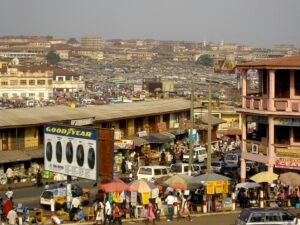
Ghana’s Kumasi Market in 2011
#1 – THE COST OF LIVING IS CHEAPER… BUT NOT REALLY
I think this is where a lot of Westerners who decide to move to poorer countries stumble, in not fully appreciating this reality. Yes, currencies like the US Dollar and similar first-world monies trade high in Africa. For instance, with my knowledge, I could live pretty in Ghana on an average of about $500 per month.
The caveat is that, it’s a lot more difficult to get that kind of money over here to begin with. Even a solid $500 per month, you’d be surprised how many people in Africa aren’t earning nearly that much.
Some items, such as basic foodstuffs, may feel less expensive than their foreign counterparts, but others do not. For instance, buying food from Burger King in Accra basically costs about the same as it does stateside. The same goes for some electronic and luxury goods, like iPhones. In fact, since the West has more wholesale outlets, department stores and processed foods, there’s certain items you can get over there even cheaper. Foreigners have different tastes from the locals. And acquiring the products you’ve come to love at home can cost a pretty penny,.
Many expatriates have good jobs, setup successful businesses or enjoy funds regularly coming in from abroad. Their income may be higher than the average local. But in attempting to meet all of their needs and wants, they find out that the money which remains isn’t enough to make them feel secure.
#2 – MANY FOREIGN ITEMS SIMPLY AREN’T HERE
Even if you have all of the money in the world, as an expatriate in Africa there are certain foreign items that can’t be found. You can go to the country’s to the biggest malls, the capital’s shopping districts, peruse every corner and still return unfulfilled. This isn’t so much the case with electronics. What it does affect is categories like food and clothing.
With the latter for instance, your favorite brands may not be available. Or if they are new and authentic, chances are they’re a lot smaller. So if you really favor a brand like, say, Ralph Lauren, you may rather opt to buy secondhand items from abroad. But still, you have to find them first.
The food situation is even worse. There are a number of favorites that I haven’t had since leaving the United States.

A typical supermarket in Nigeria
On one hand, your body adjusts. But the idea of wholly adopting the native diet may not be realistic. The best you can do is seek out local alternatives. You’re not going to find the likes of Wise potato chips in common places. But if you’re lucky, you may come across something similar and even less expensive.
#3 – MARRIAGE IS TAKEN MORE SERIOUSLY
Americans have a relatively-lackadaisical attitude when it comes to marriage. Africans are a bit more serious when it comes to making those types of commitments.

Traditional marriage ceremony in Nigeria
Many Africans maintain connections to their ancestral roots. In these types of old world societies, patriarchy and continuity are still strong. So there is a higher expectation of marriage and a lower tolerance for divorce.
In Africa, you have to be more careful how you throw around the M word. Arguably, most African women go into serious relationships hoping for marriage as the outcome.
#4 – SOCCER IS THE PREDOMINANT SPORT
If you’re from Europe, you’re already use to this kind of thing. But coming from the U.S. or another country where people don’t really give a damn, prepare yourself for an awakening.
Soccer has an additional dimension from other professional sports, because it’s played on a national level globally. Even local football clubs, in Africa, have sort of a tribalistic feel to them. It’s not simply about being a super fan. Since African cities are invariably associated with a particular tribe(s), it makes the fandom more territorial rather than just choosing who they’re favorite team or player is.

Ghana’s men’s national football team, the Black Stars, are the pride of the nation.
And there’s nothing like being in a football country when the men’s national soccer team is engaged in a high-stakes ‘match (against another country). It’s something you have to see to truly appreciate, how many people – man, woman and child – become emotionally vested in the match.
It isn’t like in the U.S., where only now, after the 2026 World Cup, people are becoming mildly interested in soccer. And it isn’t like when a state or city team wins, and only residents of that locality celebrate. You hear shouts of excitement coming from any and everywhere, and you know that the entire country is concurrently watching the match.
#5 – YOU CAN MORE EASILY LIVE A HEALTHY LIFE
Africa is closer to nature than the West. In the Motherland, you usually don’t have to travel far, if at all, to come across fresh produce. And out here, the likes of fruits and vegetables are actually less expensive than processed foods.
You can also more easily opt to live in a more rural setting. Urban centers are expanding at a rapid pace, but you can usually find somewhere greener to settle which isn’t too distant.
Adopting more of a local lifestyle can produce better health, and it isn’t all about dietary adjustments. People out here also rely less on machines in general. Americans may not be growing up with robots yet. But you’d still be surprised how many basic luxuries we enjoy when compared to Africans.
For instance in Africa, unless you’re really privileged, you may find yourself carrying water from time to time. It may even be something as simple as carrying a bucket from outside the house into the bathroom. But as an American ask yourself this. When was the last time you carried something as heavy as a bucket of water?
Americans have to go to the gym to build muscle and burn fat. That’s not generally the case in Africa. Here, if you’re able to adopt certain aspects of the local culture, not only will you consume less fat, but you’ll also be exercising a lot of times without even realizing it.
CONCLUSION
The idea of Africa being some type of paradise is idealistic fantasy. But at the same, it isn’t hell neither. The key to surviving boils down to two basic factors – income and expenditures.
Ghana isn’t a credit-based society, where you purchase goods and services and pay later. So you have to know how to navigate yourself financially. And after that, everything else comes relatively easy.