Why Is Kaliningrad Separated from Russia?
First of all, let’s establish this. We all know of Russia, the large country at the northern tip of Eurasia. But there’s also a smaller nearby region that historically is known as Prussia, not to be confused with Russia itself.
The borders of Russia and Prussia do not touch. And you may notice, if you scan a world map, that Prussia, which is situated in Central Europe, isn’t listed. That’s because Prussia is not a country nor, as it currently stands, an officially recognized territory.
In the old days, it was a kingdom belonging to the Germans, with a number of independent states under its jurisdiction. Germany’s mastery of Prussia persisted into the mid-20th century. The region was instrumental in fueling the Nazi war machine with resources, including high-quality soldiers.
East Prussia lies at sort of a halfway point between southwestern Russia and northeastern Germany. So surrounding countries, such as Poland, Belarus and Lithuania, found themselves having to deal with the brutalities of World War II. Due to its geographical positioning, Prussia was regularly targeted by the Germans or the opposing Allied Forces, including most notably Russia.

A historical map of Prussia. Notice Konigsberg, aka Kaliningrad, on the coast of the Baltic Sea, near Lithuania
KALININGRAD IN WORLD WAR II
For instance, due to being a vassal of Germany, Kaliningrad, which is part of East Prussia, was bombed by the British in 1944. And less than six months later, in early 1945, the Russians, who also had beef with the Germans, laid siege to the city, with about 60,000 people losing their lives.
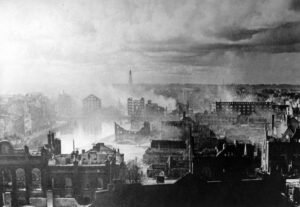
A scene from the British bombing of Kaliningrad in 1944, during World War II
So when the Allied Forces, including the U.K. and Russia, emerged victorious from WWII, they decided to divvy East Prussia up. Germany started losing control of West Prussia in World War I, and by the conclusion of WWII, it was completely granted to the Polish. And as for East Prussia, it was basically split between Poland and Russia.
Kaliningrad, which is also known as Königsberg, was the capital of East Prussia. And it was given to Russia as part of the 1945 Potsdam Agreement, on the eve of the end of WWII.
KALININGRAD IN THE AFTERMATH OF THE SOVIET UNION’S COLLAPSE
Now to note, what we call Russia today was officially the Soviet Union, up until about 30 years ago. Russia was the metropole, if you will, and it controlled a number of countries outside of its border. That included Belarus, Lithuania and Latvia, which lie in between the Russian mainland and Kaliningrad.
The Soviet Union had its day, but it eventually dissolved, officially, in late 1991. Leading up to that event, the republics under its control gradually begin to secede. Lithuania pulled out in 1990 (being the first Soviet republic to bounce), followed shortly thereafter by Latvia, Belarus and all of the rest.
Meanwhile, Kaliningrad is not a former Soviet republic. In other words, it’s not a country in and of itself. Rather, it is officially a Russian territory.
So when Belarus, Lithuania and Latvia pulled out, i.e. when the Soviet Union collapsed, Kaliningrad was cut off, politically, from the Russian Motherland. And that is why it is separated from Russia.
During most of the 20th century, Russia controlled the territories in between. Since the 1990s, the Russians may not have direct land access, politically, to Kaliningrad. But it is considered an all-important extension of the motherland.
THE IMPORTANCE OF KALININGRAD
For instance, it is the headquarters of the Russian Navy’s Baltic Fleet. In fact, Kaliningrad is the westernmost territory of Russia, bordering the Baltic Sea, which leads out into the Atlantic. And it isn’t as far north as the Russian mainland. So besides military advantages, it is also an integral part of Russia’s transportation and trade system.
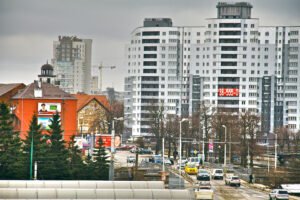
A scene from Kaliningrad in 2024
And there appears to be other benefits to Kaliningrad being situated in Central Europe as opposed to Russia proper. It is regularly ranked as one of the best and preferable Russian cities. For example when Russia hosted the FIFA World Cup in 2018, they used Kaliningrad Stadium, where the first match was held, as one of the venues.
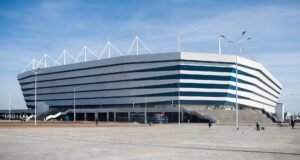
Kaliningrad Stadium, in 2018, when Russia hosted the FIFA World Cup
What’s being suggested here is that Kaliningrad is not only a beneficiary of Russian wealth. It’s further blessed by being situated more into the European mainland. So basically, it’s just as developed as other major cities in the region.
CONCLUSION
Many people may not know that, even after the collapse of the USSR, Russia has a territory outside of its own borders and not one that they’re fighting over. Kaliningrad was never an independent country nor Soviet republic to begin with.
The Russians won the city in the aftermath of World War II. At the time, Kaliningrad was devastated, being the victim of violent bombings. But Russia proceeded to develop it into arguably its most-impressive metropolis. However, by the looks of things, its borders will never touch the Russian mainland proper, as there are a couple of large, independent countries that lie in between.